PART1 – UNDERSTANDING DOCUMENTARY
Poetic mode
A poetic documentary is one which still tells a story but focuses more on subjective interpretations of its subject(s) characters and events may remain undeveloped in favor of making a particular mood or tone. They highly depend upon sound to portray a story or mood which helps fill a storyline, they also commonly are edited deliberately not in time with music. Poetic documentaries are said to ‘weave together images and music to make a particular emotional experience’. Below could be a exemplar of a poetic documentary, there’s no visible storyline however it represents a particular mood and tone.
Expository mode
The main and out and away most noticeable difference between a poetic documentary and an expository documentary is that during this one will have narration over the highest of footage, and therefore the film usually uses the narration to inform the narrative of the story (see what I did there), where poetic mode the film is formed by the filmmaker and uses their aesthetic and interpretation of a theme, whereas expository mode collects footage and so uses the spoken narrative over the highest to inform the story. Expository is that the most used documentary mode and is employed commonly for things like film features and news stories. Below is an example of an Expository documentary, this fits the outline of employing a narrator to inform a narrative.
Participatory mode
Participatory mode is when the filmmaker does interact with his/her subjects instead of just filming and observing them, the interaction is present within the film, the only style of this may be that the film makers voice is heard within the film, Nichols’ himself described this mode like this: ‘the filmmaker becomes a social actor (almost) like all other (almost because the filmmaker retains the camera and with it a degree of potential power and control over events)’
Observational mode
An observational documentary is that the closest to the reality you’ll get. the main target of an observational documentary is simply to determine, and rather than forcing your opinion onto the viewer you allow them to decide their own opinion, there are some basic rules that ought to be followed if the filmmaker is trying to form a purely observational documentary and these are… no music, no interviews, no scene arrangement of any kind, and no narration. These key points are what distinguish it thus far except for the other documentary mode. this sort of documentary should even be edited in an exceedingly form so the viewer is seeing firsthand.
Reflexive mode
Nichols’ says that this mode of documentary is most confused with participatory mode and he has always remained vague about their differences, the most difference that I can see if that the participatory documentary has the filmmaker as part of the documentary and it’ll even have the filmmaker as a key a part of the story, whereas the performative engages the filmmaker to ‘but to constructs subjective truths that are significant to the filmmaker him or herself’, the film maker could even be visible within the film and freed to openly discuss his or her perspective in relation to the film being made.
Performative mode
Nichols’ says that this mode of documentary is most confused with participatory mode and he has always remained vague about their differences, the main difference that I can see if that the participatory documentary has the filmmaker as a part of the documentary and it will also have the filmmaker as a key part of the story, whereas the performative engages the filmmaker to ‘but to constructs subjective truths that are significant to the filmmaker him or herself’, the film maker could also be visible within the film and freed to openly discuss his or her perspective in regard to the film being made.
(All information from: https://en.wikipedia.org/wiki/Documentary_mode)
All the three documentaries are very different. I have chosen to analyze, Pockets which is an observational documentary, Twelve is an expository documentary and Maldives which last but not least is a poetic documentary because of its use of music and cinematography. Pockets is what it says on the tin really, it’s a short documentary about what things or items people carry in their pockets every day and everyone’s answer is very different, this gives an insight to what kind of person they are it uses very short interviews so that we hear a little about why they carry these items with them all the time. Twelve also tells a narrative which is told by the main subject of the film who we find out is running 12 marathons in 12 months, only one person features in this documentary and that is because the filmmaker has decided that she should be the main focus and no one else should get involved, it uses very cinematic footage as ‘b-roll’ when it changes between the interview of her running through some woods. And finally, the one that I chose to analyze is called Maldives and I don’t really think that this one has a narrative, and starts to begin with a ‘holiday vibe’ with a drone shot of a superyacht which then progressively turns darker and more harsh as the sun sets, I would defiantly say that Maldives is a poetic documentary because, it doesn’t have a very strong narrative whatsoever and instead turns to cinematics to tell the story. I would say that, twelve gets the closest to the truth of the subject because it is one woman telling her story in detail and almost narrating the story herself. Whereas in Pockets there are multiple people all telling different stories, I would say that Maldives gets the least close out of all the films because of its lack of narrative and pockets sits in the middle, with its multiple different and very short narratives.
PART2 – PLAN AND MAKE A DOCUMENTARY
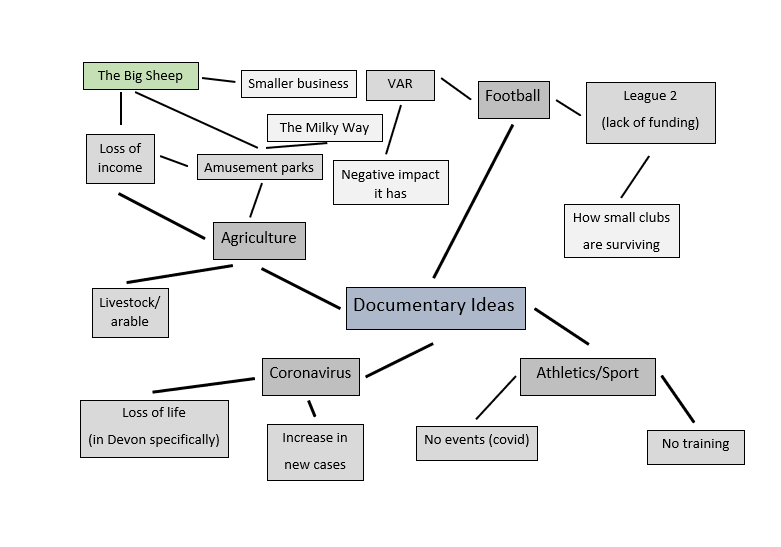
The ‘focus word’ for this unit was identity, and the way we decided to portray this was through Rick being the owner of a moderately sized business. Rick is very passionate about ‘The Big Sheep’. The way that we decided to fit this into the documentary was by only interviewing him, and as the owner of the business this worked very well. Also when we created the question list we had in mind that although we wanted to get factual and statistic information but mainly his opinion, as this shows his views… one of the questions that shows this is number eight: If the pandemic remains persistent, could your business still survive this time next year? To which he replied with an answer which definitely showed the viewer a lot about him as a person, his answer was something along the lines of that his mind has changed and if we had asked him the same question a few months ago that his answer would have definitely been different. But on the day of filming he said that he is optimistic that the business will survive next year. It also delved into his identity as a transparent and how open and honest he is as a person, as even questions about money he still answered where most other business people wouldn’t. He also openly said how many staff he has had to make redundant. I think that the documentary (as it is mostly an interview) gives a very good insight into Rick’s identity.


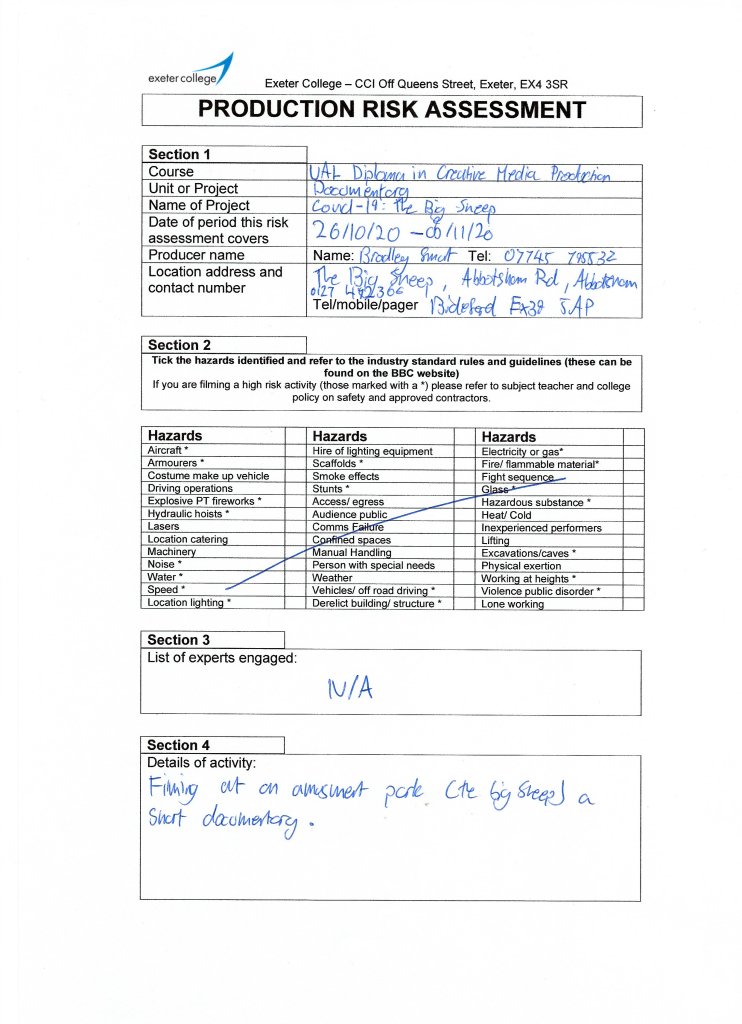
Production Files/Documents:
 Bradley Smart