

PART ONE – CONCEPT ANALYSIS – INDIVIDUAL WORK
(150 words approx.)
Our short film is called ‘The DeVito Code’. At first, we thought it would be hard to recreate however there is always a solution! The initial paperwork was not very descriptive and came without a script meaning we will have to improvise with dialogue and might have to add in extra music to make the film feel more full, In the advice/guidance section of the cover sheet it said that they wanted the shots to be very smooth and to have continuous shots as much as possible and also to only cut away to a different shot when it is absolutely necessary, on the storyboard we as a group thought that the timings of the majority of the shots were incorrect or inaccurate, but luckily it said that the timings were a very rough estimate and to change them if we need to. We don’t have any major concerns about the paperwork and think it is clear enough that we can recreate it to an accurate extent the film that is described.
PART TWO – FILM COMPETITIONS
(500 words approx.)
South West Adventure Film Festival
South West Adventure Film Festival is a celebration of outdoor films highlighting the adventurous spirit of the South West of England and beyond. 2020 was due to be the first year that the SWAFF film festival was running but due to the worldwide pandemic it was unable to happen, it launched on the 25th of October 2019 and was due to take place on the 26th and 27th of September this year (2020), this event is more than just a film festival although that is what the main event that everyone would have attended for. It promised climbing and canoeing as a couple of activities that would be possible, they did specify a length of filmmakers to stick to when creating their short films which was a time of five to twenty minutes along with a file format of either an mp4, mov or similar. There was no standout prize for the festival and on their website, it said that it was to be unveiled at the festival itself. Unfortunately, there have been no winners this year yet and no previous winners as the film festival is so recent. There is another rule that the film has to be of an adventure genre and also it must either be created by filmmakers who are based in the south west or it can be produced by someone based outside of the south west but in this case it would have to be filmed completely in the south west.
Two Short Nights Film Festival
The 19th Annual Two Short Nights celebrates and promotes short films and the people who make them. The festival is proud to nurture new and emerging talent through selected screenings, workshops and our famous 48 Hour Film Challenge. The Two Short Nights film festival allows films of up to a length of twenty minutes which includes credits at the end. At this festival you can win different awards for the different sections, they have an audience choice award where quite obviously the audience chooses what their favourite film is and then it will win the award, there is also a best short film award which is voted for by judges instead of the audience and, finally the best 48 hour film where a crew must plan shoot and edit a short film within the time period and then wins an award if their production is good enough! The previous winner was a video called ‘The Fisherman’ by Zoe Martinson which has also won many other film festivals such as the ‘Pan African Film Festival’ and even has its own website which can be viewed here. The storyline is about an older fisherman goes out to sea and returns to shore with a talking fish, it is set in west Africa in the home of a developing area. A short synopsis of this comedic film is below.
An aging fisherman goes out to sea one day and returns with a talking fish. Set in Ghana west Africa, this quirky comedy explores the need to stay relevant against the backdrop of a developing nation.
PART THREE – MAKE THE FILM
PART FOUR – PRESENT YOUR FILM
How do you rate the initial paperwork you were given?
The paperwork we were presented with initially had good points and bad points. The storyboard was in-depth and showed us exactly what they wanted us to do. However, the documents lacked a script which meant we had to improvise, and we ended up coming up with the scripts on the spot when we were filming (which I think would have actually been better than an original one).
What was the process of production of the project?
Overall making the film went well, we all worked well as a team; however, the storyline was different to what we would have chosen to do ourselves which then makes it harder to show and give them exactly what they want.
Which parts of the paperwork you were given were most/least helpful?
We were given the storyboard, character profiles and a synopsis so from those documents we could get a very good idea for the style of film they wanted to create. It also helped that the storyboards were very detailed with the sounds that they wanted to recreate. I think we managed to recreate the film that they pictured on the documents to the best of our ability, so I would say that the most important document was the storyboard because they contained the most information about the production, I don’t think that there was any paperwork that wasn’t helpful at all as they all added more useful information that was needed for the production.
What type of film were you aiming to create?
As a group, I think that we were aiming to create a film that was fast paced to start with and then progressed to slow down as Quentin’s life got worse, it was definitely planned out to work this way and I think it is an accurate representation. The genre of the film is meant to be a comedic documentary style and I also think that we managed to achieve it to a heigh standard.
Noticeable shot types?
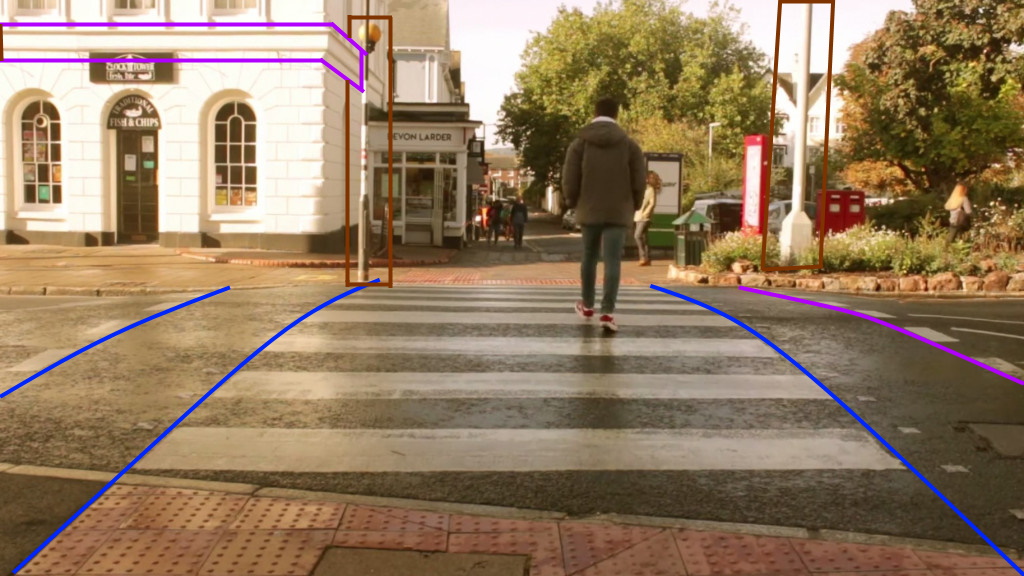
When we were out shooting for this project we realized that Quentin wasn’t doing much ‘movement’ in any of the pictures, so we decided to add the sequence that started after he wakes up to make the scene more interesting. In the frame above there are lead lines all over the shot, we chose this because it adds a lot of depth to the shot, another reason that this adds depth which is closely related to lead lines is that the rectangular boxes of the zebra crossing get smaller and smaller the further away they get however the human eye knows that they are all of equal sizes in real life.
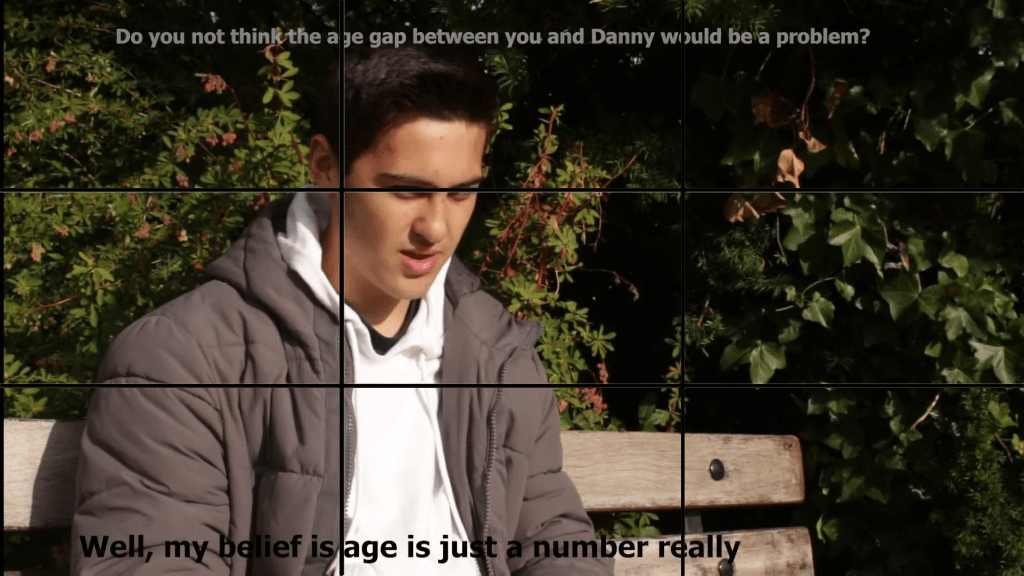
Here I have added a ‘rule of thirds grid’ to a frame within or video and this clearly demonstrates how we framed the shot with Quentin in the foreground and on the intersecting crosses of the grid and the scenery of the bushes and trees out of focus in the background.
Additional notes
While we were planning to film our production, we thought it would be a really good idea to use a student accommodation suite as the set for the first half of the storyboard as it would have given us everything, we needed all in one place. This failed to go to plan as we emailed many different buildings, but they all declined because of the ongoing virus, so we had to improvise by booking out a classroom. I think that if we were to have fully produced this short film ourselves we would have completely redone all of the paperwork and especially made a script, as I think it would have made the whole filming process much easier.
Production Files/Documents:
 Bradley Smart