PART ONE – Job Roles in the Creative Media Industries
Exploring job roles:
Producer
I have been a producer for Box and the Documentary, I would say I really like overseeing a team of people because it allows me to see a project coming together, I also think that I have been quite organised and have always met deadlines because of my good organisation skills. If I were to choose a job role at this point to pursue as a career it would be a producer.
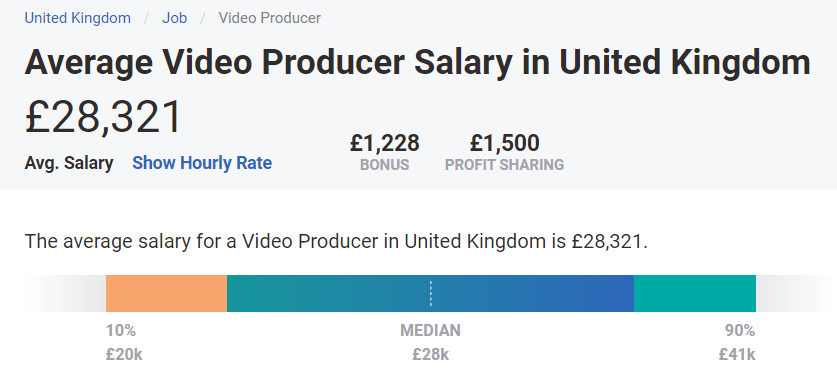
A producer helps with every aspect of a production, and they are involved from the very start to the end of a programme. They always have the final decision and will produce ideas and hire scriptwriters to get the ideas down on paper. They would work on ideas from the director and approve production costs, they also hire the core team and will delegate responsibilities to a line producer. But with all this it means that they have the overall responsibility for a film hitting its deadline and the health and safety of everyone involved. A producer must have an extensive knowledge of how to produce a full film and how to tell a story, but most importantly good leadership. To get into being a producer you should consider a Creative media vocational course at college, and if you progress to go onto university then you should do either English, film studies or media studies.
PayScale (2020) Average Video Producer Salary in United Kingdom. Available at: https://www.payscale.com/research/UK/Job=Video_Producer/Salary (Accessed: 12/11/2020)
Editor
So far into this course I have edited, Box and Crime Drama projects. I have enjoyed editing both projects because it allows me to have my own creative freedom and edit the video to be what I want it. As I say below I defiantly. Have the most experience editing over other roles, but I am looking forward to experiencing others.
An editor’s jobs are to take all the footage that has been shot and to compile it all together into one final sequence that makes sense as a story, films also tend not to be shot in the order that the story unfolds, and this may be done for convince purposes for example if you had rented a castle it would make sense to film all the shots inside and outside the castle on consecutive days even if this is not in chronological order. They work closely with the director to decide how to make the most of the script. Music is usually the last thing that gets added to a film and this is after the producers have approved what they call a ‘directors cut.’ Then the editors will oversee the sound mixing. An editor must be good at communication because his/her opinion may not always be correct, and they will need to take input from the director and producers regularly. They must also work with good rhythm to tell the story in an effective way. To get into being an editor a vocation course in media production and technology is the perfect option.
PayScale (2020) Average Film / Video Editor Salary in United Kingdom. Available at: https://www.payscale.com/research/UK/Job=Film_%2F_Video_Editor/Salary (Accessed: 12/11/2020)

Director of photography (DoP)
I was DoP/Camera Operator for Crime Drama and for my Documentary, out of the job roles that I have done this is defiantly the least favourite but still in my top three… if that makes sense. The DoP and Camera Operator roles get confused very easily, typically a camera operator is the person with the role and position where they operate the camera, however on smaller shoots the camera operator and DoP can be the same person. But on much bigger shoots it is likely that the DoP and Camera Operator will be separate people.
The DoP is responsible for the image that everyone sees on their screen as they will have captured this. They work closely with the director to discuss the look and feel of the film, they will discuss requirements for lighting and sound with the gaffer and grip, they also discuss special camera moves with the camera operator. It is the DoP’s main job to make sure every shot is usable and to flag up the ones that are not. A DoP needs to have a keen eye for composition and know how to use techniques to affect emotion and to also have technical knowledge of how to use cameras. And to be able to think quickly and make decisions under pressure. To become a DoP it is also a clever idea to take a creative media vocational course.
PayScale (2020) Average Camera Operator Salary in United Kingdom. Available at: https://www.payscale.com/research/UK/Job=Camera_Operator/Salary (Accessed: 12/11/2020)

Working conditions:
For all these roles you will obviously need a keen interest in filmmaking, and as already specified, it is recommended to take a vocational ‘filmmaking’ type course or a media A level as these will give you the experience needed to progress further. The working conditions would be different for each job. For a producer, the working conditions would be most stressful as they must effectively manage the whole production, an editor would be less stressful as usually they are not required to manage a whole team, however this might be a case on a large-scale production, but editors can usually work from home as it is quite an easy job for remote working, but sometimes you may be needed to work in an office because it is much easier to get advice and input from people around you. A camera operator or DoP’s conditions would be the most different as they are constantly in various locations and will have the least input in what they do as a job because a camera operator is told what to film by the DoP, so it may not be enjoyable conditions for someone who does not like being bossed around. Being a DoP must be harsh working conditions because as I previously mentioned, you are responsible for all the footage that is handed off to the editor and sometimes it can ruin a film if the shots are not framed or if they do not have good composition, they also like a producer must manage a team of people and make sure everything within a shot is correct and that they are happy with it.
Comparison of all three roles:
All three of the roles have hugely different wages, but this also comes with the different conditions stress levels and much more. For example, the best paying role is a producer with the highest average salary of £38,000. With a camera operator and then an editor being about the same average salary of £24,500, so comparing a role as a producer to a camera operator or an editor already has the advantage of being a much better paying role by quite a significant margin, but this could be that it requires a lot more effort and could be a more stressful role, at the end of the day for me the job must have a good enough wage for me to live on comfortably and I would much rather be happy than in a stressful role that pays a higher wage, I think that I would be happy with the pay/salary from either, but obviously would prefer the higher wage that a producer role pays, but this would be conditional if the job was enjoyable or not. The working conditions for a producer and a camera operator would be the most similar because both roles involved are ones that take place during the physical production of a film, I feel like I may enjoy this more and this is because I usually like to feel involved with a team of people, whereas if I were an editor, I would probably be sat in a room on my own, working on the postproduction and feeling less involved, although sometimes I like my own space rather than working as a group, I definitely have the most experience going into an editing role because it is something I have had previous experience in, I have worked with multiple different software’s (starting with Cyberlink Power Director, moving into Sony Movie Studio and then Vegas, and now finally working with Adobe Premier Pro).

So, I have the most potential within that role because I have the most experience in comparison to the other roles. But since I have started Exeter College throughout the projects, I have worked on I would looked more into being a producer or even a production manager because I like being able to manage a team of people, I enjoy this because I have realised that I am particularly good at managing and organisation and that I can meet deadlines very well whilst keeping the quality to a high standard. As a professional I think that being a camera operator would be the least interesting, but I am still interested in pursuing it (if that makes sense), but if I could choose a dream job role it would be a producer for reasons that I have already listed. And an editor would be an excellent job as it is something that still gives mostly complete creative freedom which is also something I would look out for/would make a job appeal more to me.
Create a mini career plan:
Firstly, the best option is to study a course relevant to the to what you eventually want to do in the furure, as this over the two years at college will give you the experience needed to be able to succeed the best in the real world. By studying these subjects relevant to the role, it will allow you to be more knowledgeable and it should allow you to know if this is something that you want to pursue in the future. The second option is to get work experience within the role or subject, the only difficulty with this is that because of many reasons which sometime include insurance with workplaces they will only allow people for work experience over the age of 18, the best way to get these experiences under the age limit would be to do them through your college or school as these are likely to have careers teams to help with this. Another option is to go onto university and study a degree and afterwards go straight into a working environment, the trouble with taking a degree is that you must be extremely certain that your chosen route is the correct one that you would like to go down, this is because you do not want to waste all the time and money that goes into university to get something you do not want to do out of it. You could also get an apprenticeship which put simply is a job, but it also comes with the training required to move on further, so effectively you are getting paid while you are learning (a great option!), however the problem with this is that there is a lack of apprenticeships surrounding media (specifically starting at a 16-age category). The final option is to become a trainee, and this is a job where you learn the essential skills to progress within the industry, it is most common to be a trainee after you have left college or graduated university, to find out more about becoming a trainee you should go to an organisations website (eg: BBC or ITV) and see if they have any programmes available for becoming a trainee. All the different options will take different amounts of time, for example you could only do one year at college and then progress into an apprenticeship, or you could spend the full two years. I think that I will stay at college to complete the extended diploma, and then go into the industry as a trainee or an apprentice. Personally, I would not say that it is a necessity to attend university, as I think especially in TV and Media it is easier to learn and work at the same time, but this is just based on what and the way I find learning most effective. Of course, if you were to attend university academically you would have a much better knowledge of roles and the industry but because of my preference I will not do it this way. For me I really think that some form of work experience would benefit rather than further education, so my ‘mini career plan’ now is to complete this college course (UAL DIPLOMA IN CREATIVE MEDIA PRODUCTION (TV AND FILM) – LEVEL 3), and then to progress further in the form of an apprenticeship or a job as a trainee within the industry.
Mini evaluation of my own performance:
So far from the start of college throughout all the projects, I would say that I have been very organised, the main way I have been able to stay organised is by using the app ‘Microsoft To Do’, I have this app installed on my phone and laptop where it allows me to launch it up within seconds and then I can make a quick to-do and mark it as complete whenever it is complete. I do this for everything weather its little or small. You can also set individual reminders and deadlines for which will then give you an option to sort by when the different items are due in.
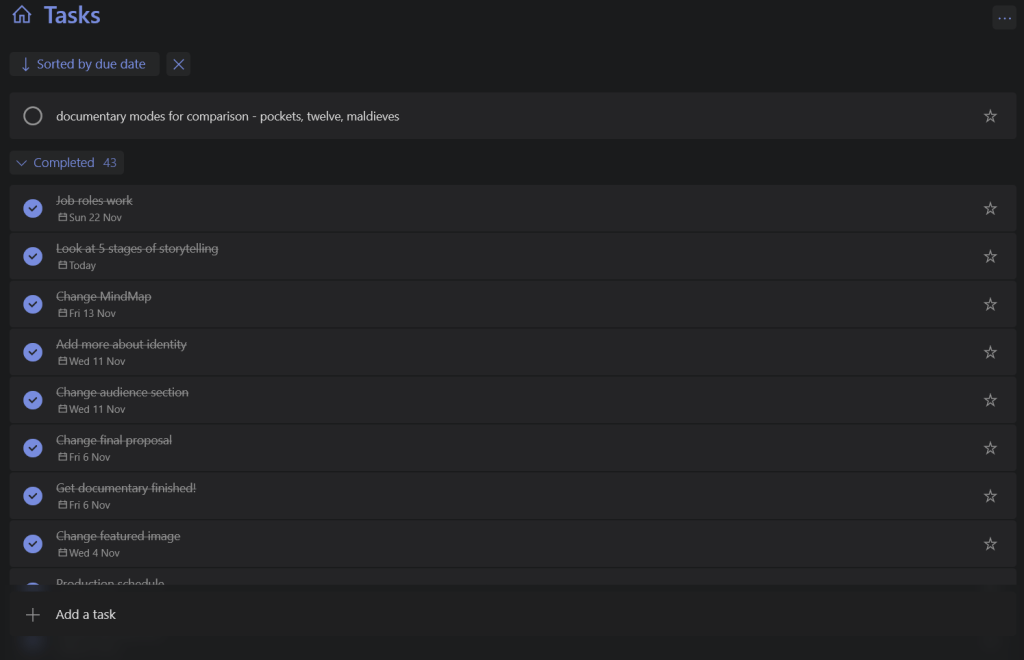
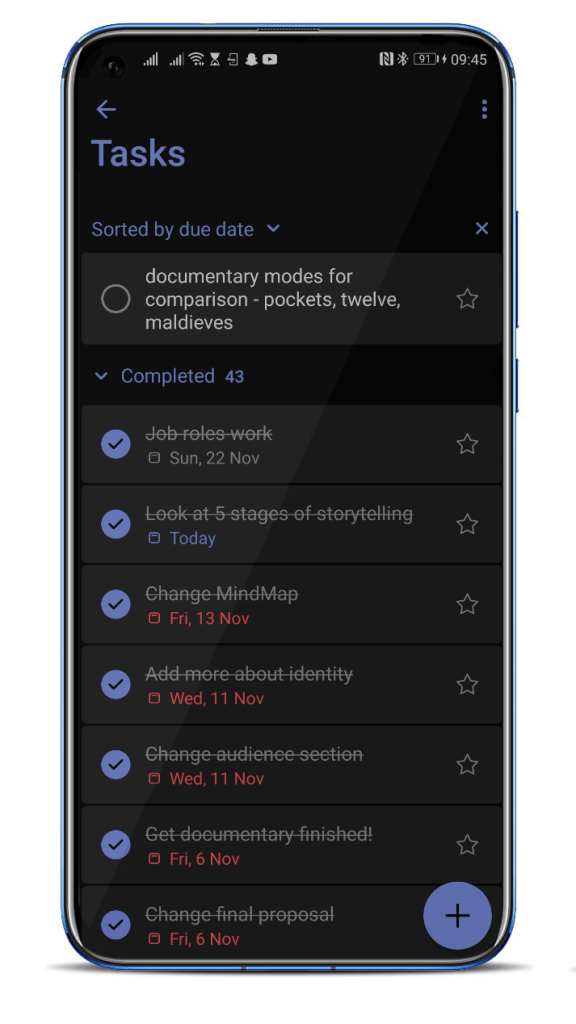
This picture shows my previous tasks that I have set myself in order of due date.
As you can see the descriptions/titles of each are not very descriptive for someone else looking at them but if I know what they mean that is all that matters, for example if something needs doing like some paperwork needs filling out etc, I will just add it into Microsoft to-do and then I will remember to get it done. When working in a group, I would like to think that I am reliable. I always try my hardest and aim to do my best, as one of the things I hate most is letting people down so I try and do this as little as possible. So far, I have not missed a single deadline, even when I worked on my own for the ‘Crime Drama’ unit, I would say that the only way that this has been possible is that I do sometimes pressure my team or group into getting stuff done a lot quicker than they usually would, I do not like putting people under pressure but I do feel that in some cases it is necessary. I would say that I have demonstrated an elevated level of professionalism, although this could be something to improve on, the main way I have shown professionalism is when me and another group used a car park owned by ‘Exeter City Council’ to film within. In doing so I had to create multiple risk assessments before we were even allowed to set foot within the car park. For me this showed professionalism and I enjoyed doing this for another group too as they saw this too and obviously appreciate the help. Finally, I think that it depends on the size of the project to weather I work better in groups or by myself, I worked on my own for the crime drama project and I had the final film completed before the deadline by some margin, the advantage when I work on my own is that I am my own boss, and that if anything does go wrong or if I miss a deadline it is completely and only my fault whereas when working in a group the blame could be put on someone else who may not be doing as much work within the group as they should be, but then there is another side to it where it could sometimes be easier to spread the workload out between multiple people rather than taking it all on your own. So, I would say that I prefer working on my own, but I still enjoy working in groups just as much.
PART TWO – Evaluate Your Finished Work
(Apply narrative theory to structure of crime drama and documentary)
Narrative
Our documentary was structured so that we had prepared a series of questions to ask the owner of the business and then these could be edited in a way that portrays a story, that shows a lot about the owner’s opinion. The way we decided to structure is so that it shows positivity even within a negative situation, for example one of the questions asked if he thought his business would survive this time next year if the pandemic remains persistent, this was deliberately open ended as it forced the interview to show optimism and light of a good situation, the music also shows this as the track is not a particularly sad one, but it is not positive and helps push the dialogue across to the viewer. I think the structure and narrative that we planned to come across ended up working perfectly with the visuals, audio and dialogue used.
My crime drama was structured very differently and tried to show harshness and evil, the introductory part shows a feud start between a gang of ‘kidnappers,’ it leaves the viewer on a cliff-hanger wondering how the first episode will pan out, the structure of the episode would continue this feud on throughout but with it starting to die down coming to a slow resolution, when one of the three gang members tell another some critical information that the leader had deliberately only told him. This starts a completely new argument which gets resolved in the next episode, however the viewer will not know this, as it will have a very abrupt and quick ending. I think that I could have structured my crime drama better because I can see it could be very confusing to explain in the future. However, I think that it could work, and would still interest the viewer while they are watching it, however, I do not think that the documentary could have been structured any better as it shows the story that we originally planned out to create.
Within Todorov’s theory he describes a world where there are always five distinct stages, which start with a state of equilibrium, which is then disrupted and there is recognition of this, action is then taken against this state of disruption, and finally a state of new equilibrium is formed at the end. I think that my crime drama somewhat follows this, the episode would start with a state of equilibrium where the group are unhappy with each other, which would then progress into the gang splitting up, and towards the end there would be a new equilibrium where one of the groups has left the others and this is what I would class as the restoration, as the person that has left the group is much happier after his departure, Todorov’s theory is easy to understand and the majority of narratives will be able to fit into this theory without even realising it. My documentary however was shot on a singular day in under an hour, if we had more time, I think that it would have been better to spread it across multiple days, this would have given a narrative to the video because we had to structure the edit so that it portrayed a narrative and a change in mood, although you could argue that Propps’ theory where there are specific character types which everyone within the film. And you could say that Rick (Owner/Manager of his business) is a hero for trying his best to help his business survive through the pandemic.
Representation Issues
In my documentary which I produced with Harrison we interviewed an owner of a moderately large-scale business which is a tourist attraction in the south west (north Devon) called ‘The Big Sheep.’ The owner is called Rick Turner, and we decided to only interview him for the documentary as the key/focus word was ‘identity.’ Which meant the aim of the project was to focus on him as a person and the different qualities he has. Now some people could say that this is not very fair for gender equality as we only interviewed the predominant male figure at the face of the business, however I do not see this as a problem because it was a documentary about his struggle, and it could have quite easily been a female figure at the head of a business, and this would not have changed anything. Rick is a white British male and as a stereotype this would be classed as a typical British businessperson, but as previously mentioned this would not have changed our approach on the documentary.
In my crime drama which I produced myself, it shows three white men who are all kidnappers as a group, now I think that if I, reproduced my crime drama I would have included a female character and if possible, someone of a different ethnicity, I would have done this so that it would remove the stereotype and instead challenge it. On future productions I will now be more mindful when selecting characters to participate in filming to make sure I have a broad range of ethnicities to help express diversity.
Dyer in 1997 said that ‘How we are seen determines how we are treated’ which I believe to be true, for example in my crime drama, all three males were portrayed as bad people in the sense that they were all committing the same horrific crimes, and if they are represented doing these things then that will have a major effect on our views on them as a character, Tessa Perkins also says that not all stereotypes are negative, using my documentary as an example, usually you see news stories of multi-millionaires avoiding tax and using their money for bad things however this isn’t the case with Rick, which I hope came across well in the documentary because he was very open and honest and answered all of the questions even about earnings in great detail.
Technical Issues
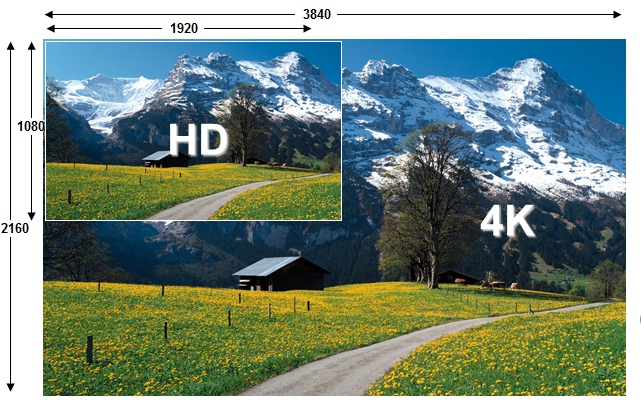
If I were to rate our filming success out of ten, I would give it a solid nine. All the filming that we carried out was successful, but there was room for improvement with the way that we filmed certain things and with recording audio, for example on the documentary which I filmed with Harrison, only one of us could be present which ended up being me, also we had planned to use Harrison’s camera to film with, so instead we used my phone which ended up turning out better than using his camera anyway, for several reasons… The main advantage is that you can scale down or crop in the image, and when doing so you will still retain a great amount of detail. This is because visually the resolution of a 4K image is 4x the size of a full HD (you could fit a full HD image into 4k four times) (only when exporting at full HD).
On the day of filming the sun was constantly coming in and out from behind the clouds, which meant the camera must adjust its lighting to still be able to get a good image (see 7:10-7:20 of the extended cut, where the sun comes out). I think that I am developing well as an editor too and I think you can tell this from the first film swap project up to the latest documentary (extended cut) that I have put together but moving forwards with editing I think that I need to improve and learn more specific techniques and work out a way for editing that works for me, for example when you zoom in a shot through editing it looks better if there are curves so it slows down and speeds up towards the start and end of the zoom and this is something that I have learnt since film swap and I would definitely change this if I went back to the project. The OTS (Online Technical Skills) section of the course has taught me the basic practical elements of filmmaking so far, especially the two which covered lighting and audio. Because It helped me learn how to light a subject/room effectively, and the audio topic showed me which microphone to use in what environment.
Audience Issues
The audience reaction to my work so far has been positive and I have received a lot of feedback, especially for the first project films swap where I edited it, and everyone seemed impressed. For our documentary we aimed it using a regional/geographical approach. And we did not use a demographic as we thought it would be appropriate for all different classes. Looking back on this now, this is still partly true, but it is better for an older age group which I would specifically say is 20-50, still leaving it quite broad but personally I cannot see it being as interesting for a younger audience, it also was not demographically aimed at a specific gender, as farming is widely known to be a male and female occupation, so we think that it would be wrong to aim it like this.
The demographic of my crime drama was much younger with an audience of 18-30, this was because a younger audience enjoys a ‘thriller’ type series a lot more. I would also say that it is mostly aimed at a male audience, although a female audience may enjoy is just as much. A psychometric audience, these are categorised into seven distinct categories, for the documentary I would say it is aimed at people who are ‘The Succeeder’, and this is because they like people that are reliable, they also have a high social status, which Rick in our documentary did, and he has very much succeeded within the ownership and management of his family-owned business, moving on to my crime drama, which I would say is more like ‘The Mainstreamer’ as there are many crime dramas out there and they all share the same properties which usually revolves around death and then coming to a resolution. This is a much more generalised audience however they are still interested in the topic. I chose this because there are many crime dramas and the typical person who views a crime drama will watch multiple series (not necessarily at the same time).
Gibbs Reflective Cycle
Gibbs reflection is an especially useful method for evaluating your work. First you should describe what happened, then you should evaluate how you are feeling, then analyse and conclude what (if) you did it again what you could do better, here is my example of this when analysing my documentary.
Description (What happened)
I went to The Big Sheep in north Devon and filmed a documentary about coronavirus and how it is affecting business, and the negative impacts it has taken.
Feelings (What were you thinking and feeling?)
I felt good after I had filmed the documentary as I felt we had addressed the points that we set out to originally and with good detail thanks to Rick’s in-depth answers.
Evaluation (What was good and bad about the experience?)
The good about the experience is that we filmed everything we wanted to within the period and we did this to an excellent quality too. The bad about the experience is that we had an extremely limited timeframe to film within (45mins) and it was very rushed, I believe if we had more time, we could have filmed to a higher quality.
Analysis (What else can you make of the situation?)
The documentary was completed fully and to a high standard.
Conclusion (What else could you have done?)
I could have taken a camera out from the LRC so that the image quality could have been improved, or even for a second camera angle which would have made the interview section more interesting.
Action Plan (If it rose again what would you do?)
If I were to do the same documentary project again, I would make sure that we had the option of using two different cameras even if one included my phone, I would also arrange to visit the site and film when it allowed for more time to do so, and this is so that we can work to a higher quality.
 Bradley Smart