Part One – (The problems)
Out of the two foley problems I have chosen to complete the WWF video. I have chosen to do this because I think that it will be most appropriate for me to work at home on because I think the sounds that are heard throughout, I would be able to recreate similar sound effects to this video in comparison to the Korean horror film. Also, the Radio Four task will be completed, and I aim to push the radio drama to a younger audience as now radio drama is only being listened to by older generations.
Part Two – (Understanding issues in sound design)
Glossary
Studio sound recording: Is sound which is recorded in a studio (a specialised facility for recording and mixing sound). These are most used to record vocals which is then layered over the top of a backing track, but they can also be used to record dialogue and instruments.
Location sound recording: Is used where it is impractical to move to a studio to record dialogue, for example an interview about a beach, is best recorded on a beach because it is a fitting location to fit with the audio, a ‘dead cat’ is commonly used to reduce wind noise.
Stationary sound: A stationary sound source is a sound which is not moving whatsoever, this means that it should maintain its pitch and volume because the microphone and subject both are not moving.
Moving sound: This sound comes from a moving source, this could also be the microphone moving past an object, for example a car moving or the microphone moving past a car.
Foley: The reproduction of sound effects, that are added into a video or film through postproduction, this could be anything from a creaky door to a glass smashing.
Ambient sound: can also sometimes be called background noise, which is noise which is never the main subject. This can be birds tweeting or cars moving along a street.
Sound effects: foley is a type of sound effect, however ‘sound effects’ is more generalised and can also be sounds produced in real time, this can never be speech. A good example would be a doorbell or thunder.
Music: can be any ‘musical’ sound featured within a video, this could be the song within a music video, or someone playing the piano at a dinner party.
Drama dialogue: dialogue that can rage a lot, the volume could go from whispering all the way to screaming, but only including the dialogue, it most commonly involves a dispute.
Contrapuntal sound: sound which contrasts between to differentiating mediums for example, happy music over the top of dialogue about a sad scenario (or the opposite)
Which Microphone
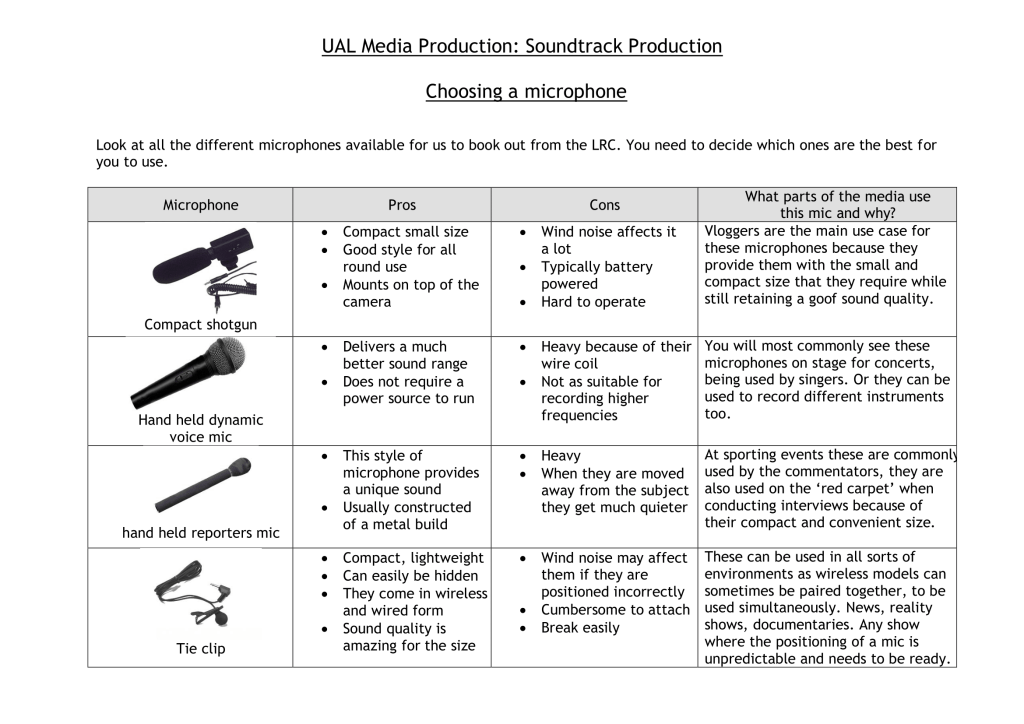

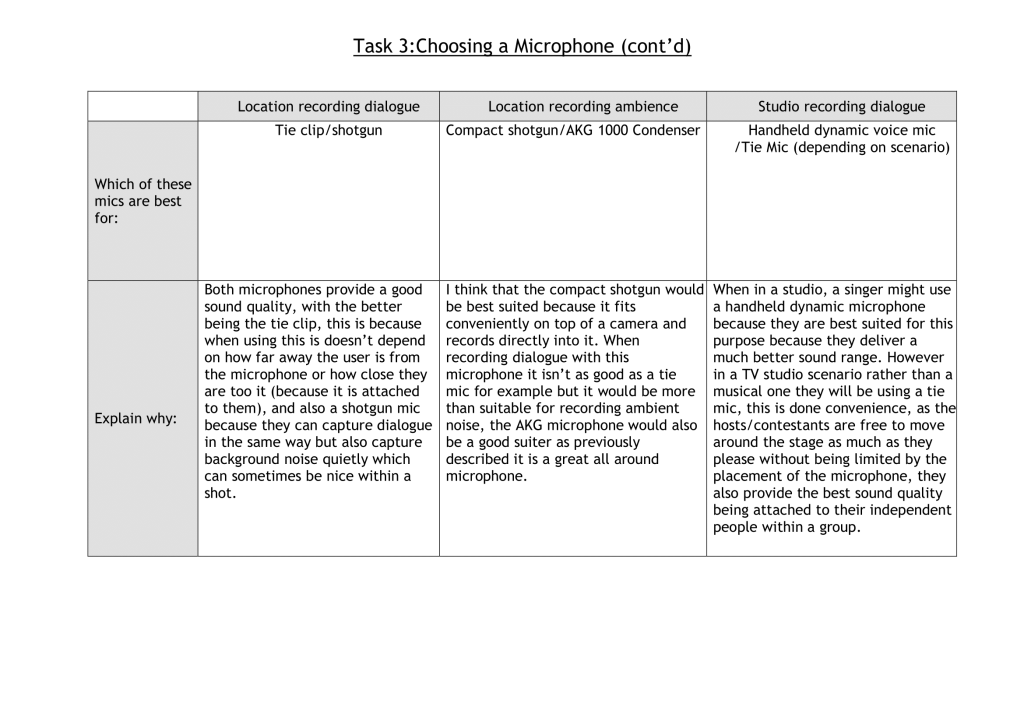
Research for Target Audience
Foley Problem
My target audience for the Foley problem will be also a young audience, 18-30 year olds, who I believe to be much more harmful and less caring to the environment than they should be. And not specifically aimed at just male viewers or female, I think that the video is applicable for both genders. Keeping this in mind, I feel like the video would make a good social media campaign, as people of this age group are regularly active on social media, and also it is the style of video that is easily understandable, and also the reach (amount of people that could see the same content) is much bigger and better especially for this audience, because a video can get shared thousands of times over and over via social media whereas this isn’t the case on terrestrial TV. WWF is also a global organisation, meaning that
Radio Problem
Primary Research:
For my primary research I am going to evaluate how many people of a younger audience would listen to a radio drama or think that they would enjoy it, I will ask a series of the same questions to multiple different people within the same age group so that there is a rage of different opinions within the survey. This will tell me weather my radio drama should be aimed at an older or a younger audience as the majority are targeted at older, this could help introduce a newer younger audience to the genre.
Question List:
- Have you ever listened to a radio drama?
Harrison – No
Sam – No
Heidi – No
Olli – No
- What radio station was this broadcasted through?
Harrison – N/A
Sam – N/A
Heidi – N/A
Ollie – N/A
- How old would you say is the average age of someone that listens to radio dramas?
Harrison – 70
Sam – 65
Heidi – 50
Ollie – 40-60
- What is the most important quality of a radio drama?
Harrison – Make it interesting, and not boring. Then people will not fall asleep at the wheel.
Sam – You must be able to understand what is going on, strong voice acting.
Heidi – The listener needs to find it interesting or they may switch off.
Ollie – I would not know because I have not listened to any.
- How many people do you think listen to radio dramas?
Harrison – 1 million
Sam – 100,000 – 500,000
Heidi – 1,000
Ollie – 10 million
I think that this qualitative research I carried out shows the persona that is associated with radio drama which is that it is designed and tailored towards an older audience. The four different people that I interviewed, (Harison, Sam, Heidi, Ollie) are all 16-17 years of age and they all answered that they have not watched a crime drama, and some of the interviewee’s did not know what a radio drama even is and I had to explain the concept to them. The age that they thought the average listener of a radio drama was all roughly the same from 40-70 which is in the older age group. They all also agreed along the same lines that it needs to be interesting enough so that the listener does not switch off, this is something I will think about when creating my radio drama.
Secondary Research:
The BBC ‘Marketing and Audiences’ department released a document which shows the types of audiences that are interested in BBC Radio Four, more specifically in radio dramas. On their station, radio drama attracts around seven million listeners a week. This shows that people still listen to Radio four and more specifically the dramas that they air/publish, this number of seven million does not include the online listeners for radio drama, so this number could be even higher. In the same document the BBC also say that the average radio four listener has an age of 56, this is the second oldest of the main BBC radio stations, being beaten by BBC radio three which has an average listener age of 57. So, when I write my crime drama, I will aim for an age of 45-55 and this is because from this research we can see that this ae group are most likely to listen. An article on BBC Writers Room says, “Radio has the fastest turn-off rate of all drama so make the audience want to stay.” So, this would imply that the audience for a radio drama would want to be immersed within the story and would need to feel emotionally attached to them, to make it worthwhile for them to continue listening. When I produce my radio drama, I will do my best to make sure that is engaging for the viewer, in comparison to the crime drama which also must be engaging this is much more important that this point comes across because you do not have the visual element and it all needs to come across through sound. This quantitative research will help because it shows me what needs to be changed or put in place when creating my own radio drama.
The WWF (World Wide Fund for Nature) is a non-governmental organization which aims to reduce the impact that us humans have on the environment that animals in the wilderness live in. Their aim is to create what they call a ‘world of life’ which means to create a world where humans live in harmony with animals and nature and they ‘seek to save a planet’. The reason that WWF want to create an advert like this is to raise awareness, when watching through the WWF video the most prominent part for me is when the cigarette is dropped in the forest and it starts a much bigger fire. It shows the viewer how something so little can cause such a big problem. The WWF charity runs from the public donations, so the charity creates an advert like this to highlight the issues and to raise money for itself.
Role of a Foley Artist
A foley artist is someone whose role it is to create sounds for film, these sounds are usually added in afterwards in post-production, this is usually done when the sound cannot be heard within the main film. Or another good example is in animations, when an animated animal is walking there needs to be sound effects of the environment, like feet moving through grass etc, that can be added in afterwards to complete the structure of the set, it is the foley artists job to create these sounds and afterwards they get sent off and added into the film, foley artists can also be on set adding in sound effects like a window breaking in the background of a shot, this would be done by a foley artist, they may also use a separate microphone for this effect so that it can be mixed in to the final production at the correct volume. The salary of a foley artist is around $200-400 (£150-300) dollars per day but this varies if you are part of a union and the size and cost of a production, because on a $10,000 dollar shoot compared to a $1,000,000 the foley artist will be earning a vastly different wage. The main reason for a production needing a foley artist is that sounds that physically cannot be made on a set, for example the lightsabres in Star Wars (which are not real objects) must be made using different sounds put together by a foley artist.
Foley is a term named after the filmmaker Jack Foley, when he was the first to start creating sound effects for films he is said to have ‘brought natural sound into motion pictures. Foley was first discovered/invented in the 1920s, it was first used during live broadcasts of radio plays. So instead of playing sound effects through a phonograph, which were a much lower quality making them seem much less realistic, they were also unreliable as these machines would break often. Instead, they started hiring sound artists which were instructed to make the sounds as soon as they happened and then broadcast over radio. It is strange to think that because Jack Foley had such an impact on the industry that someone whose job it is to recreate sound effects that their role is effectively named after him.
Ben Burtt Interview: The Sound of Lightsabers
Copyright Issues
The copyright laws for music in the UK are automatic, (this is also true for anything, not just music or sound effects) this means whenever you create a song that is ‘tangible’ it becomes your creation. If you ever wanted to challenge a copyright issue, you would first need to be part of a collection society. Some things artists can do to show the work you have created are; write down the song lyrics, record a music video and upload a copy to YouTube or another streaming site (under your name/artist name). But most importantly it has to be recognised as yours otherwise anyone could pass it on as their own. If you have copyright in the UK this doesn’t mean that you have copyright around the world, if the copyright laws in other countries are less strict than the UK, and they find your work published online they could use it to their own advantage. The UK copyright law states that “musical” works are still included under copyright until seventy years after the authors death, this is true for anything, weather it be a painting or a song. It is a common misconception that you can use a short amount of time in a project/film and get away with it without paying royalties etc, however this is not true and it still causes a copyright infringement even if you use one second of the recording unless you have permission. I think within Foley that the performer so the person that is physically making the sound should be the only copyright owner as they are the person that created the sound. It shouldn’t be the producer or recording artist because they only used their job role/profession to distribute and capture the sound. Copyright for Foley is very complicated because if you wanted to use this sound in another film afterwards the one it was originally released in has been published, you will need to get a licence from the producers, the company that own the film and also the people who first of all recorded the sound. Commonly the film company that want to use a sound effect from another will just purchase the rights much more generally, for example instead of just one sound, they may get the whole soundtrack for the film.
Using copyrighted music is also a grey area on YouTube; they use a system called ‘Content ID’ which scans any new video added to the platform using the music files registered by the rights holders, if your video does use music you don’t own the rights to it will flag your video with a ‘Content ID claim’ the most likely thing that will happen is that the video will get ‘claimed’ and this means that ads will show at the start and sometimes also throughout your video (if it is over eight minutes long) and any revenue from this video will be paid to the copyright owner, this also means that you cannot monetize the video yourself. YouTube also gives the video creator other options, for example to trim out the segment or to replace the music with something copyright free. A good example would be my crime drama, I decided to use a copyrighted song as the main sound in my video and when uploaded to YouTube it got a ‘Content ID claim’.

There are some exemptions to the copyright laws, this is called fair use and you can use copyrighted material for the purposes of… parody, research, teaching, and more. But a general good rule of thumb is to not use copyrighted material in your video as it is hard to dispute a ‘fair use claim’ through YouTube. There are lots of websites that sell sound effects, however what they are selling is a license to use a sound effect to an individual, if you purchase a sound effect through a website online, they usually allow you to create a copy for yourself and then one backup copy, but putting this file on a USB stick or CD to distribute it is a breach of copyright law. Some sound effect sites require you to pay a royalty every time you use the sound instead of or even on top of a one-off license.
The term ‘royalty-free’ is bounced around YouTube a lot, however this is useless now, because all this means is that you do not have to pay every time you use it, however you might still be having to pay for the correct license to use it to begin with. There are many copyright free sound effect sites and videos out there, and YouTube even has its own library of music and sound effects that are free to use across their platform. The creative commons license is one that gets attached to work when the author or whoever owns the material wants it to be shared and built upon freely, a creative commons license gives the author freedom to have the work they make distributed how they wish, CC (Creative Commons) have lots of different licenses that you can add to your own work, for example CC BY is the most ‘free’ of the licenses because it allows you to redistribute remix and do anything you want to the material as long as attribution is given to the original creator, this can also be used freely for commercial use. The strongest of the CC licenses is; CC BY-NC-ND, and this means that you cannot adapt or modify the work in anyway or use it for commercial use and attribution must still be given.
Sources:
Sound Effects Copyright Survival Guide 1: The Basics (airbornesound.com) (LINK NOW BLOCKED BY EXETER COLLEGE)
How I Will Solve the WWF Foley Problem
To solve my foley problem, the first thing that I will do is go through the video in Premier Pro and making notes on the foley log sheet with different timestamps to where different sounds should start and finish. Then I will record these sounds using a microphone, transfer and arrange these files on a timeline and then export the WWF video with the new soundtrack. I will find a soundtrack online which is copyright free. I think I will use both stationary and moving sound. Moving for like passing through grass, and stationary for a humming noise.
I will be doing both studio sound recording and location sound recording for things that cannot be recorded in a studio environment. The different equipment I will use will be a wireless lav mic system for subjects on location that it is hard to get close to, and in a studio environment I will use a ‘Neewer Condenser’ microphone, when I record a sound, I will use Audacity and then export it with the same file name that I write down on the foley log sheet. I estimate this will take around three days to complete.
Throughout the video I have noticed lots of scene changes, and the environment does too. I believe that the main theme throughout the video is conflict between the impact that us humans are having on the environment and the way that animals have to live, for example the bin in the ocean when the fish swims past represents us dumping our rubbish into the sea and shows us the impact it really has.
Part Three – (Solving the problems)
Foley Problem
Choose your clip
As stated, before I have chosen to reproduce the sounds for the WWF wildlife film, I will reproduce some of the sounds from the previous clip and then add some new ones of my own into it as well. A new music track will also be chosen.
Analyse the clip and make a list of sounds and which I will get from libraries
I have watched through the clip and listed all the sounds that I want to add to it, I have not yet written down where they are stored or how I recorded them as this has not been completed yet. I also have not sorted them into which sounds will be in the foot track or moves track because this will be done within the separate tracks within premier pro itself and then exported and stored. All of the sounds which I have gathered online are below with a link to the original creator’s video.
SOUND CREDITS
Music [00:00:00-02:31:20]
Bass Drum [00:42:01-00:44:19]
Bass drum sound effect – YouTube
Reverse Cymbal [00:42:20-00:45:13]
REVERSE CYMBAL SOUND EFFECT IN HIGH QUALITY – YouTube
Regular Cymbal [00:55:15-00:59:01]
Cymbal Crash – Sound Effect – YouTube
Fire Cracking [01:00:06-1:11:21]
FIRE SOUND EFFECT IN HIGH QUALITY – YouTube
Paper Roll [00:00:00-00:29:39
Papers Rustling in the wind / Sound Effect – YouTube
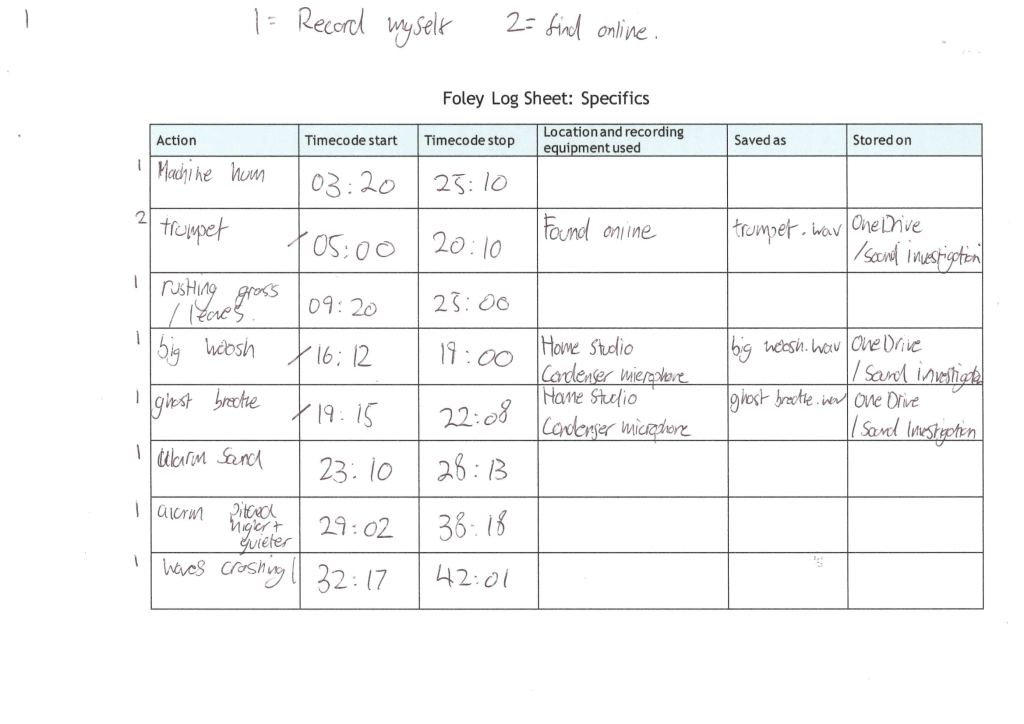
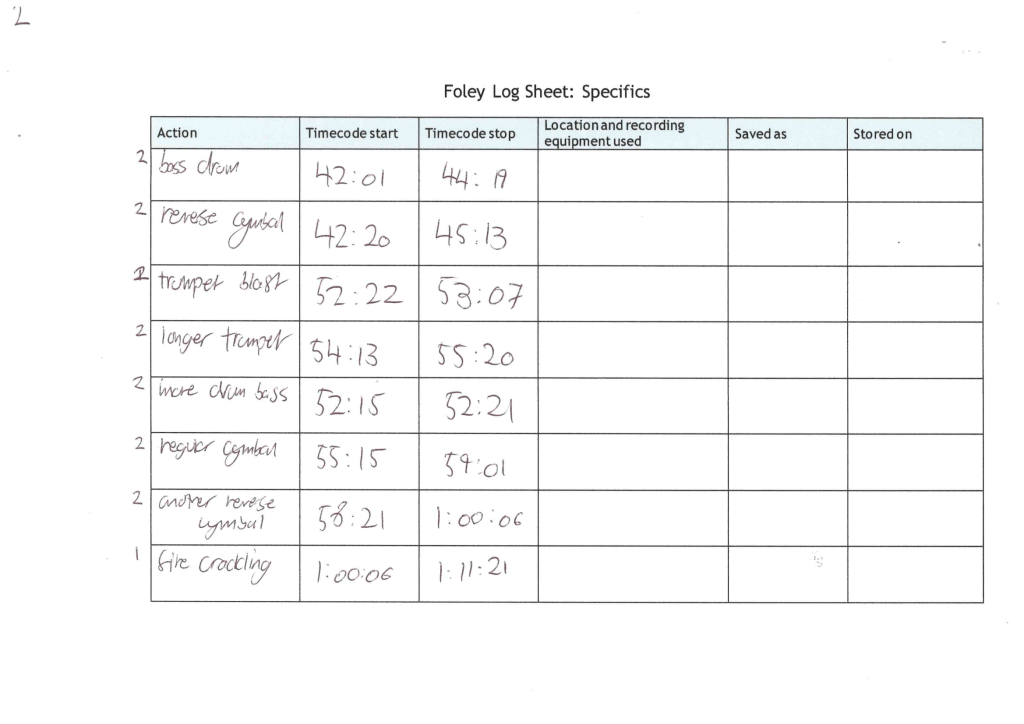
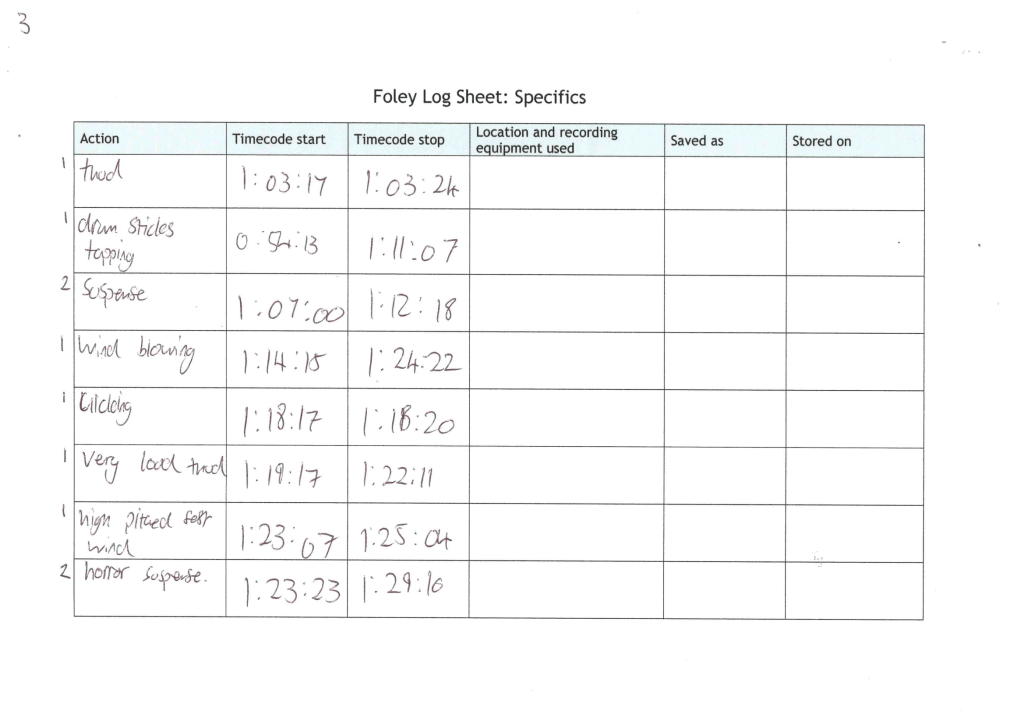
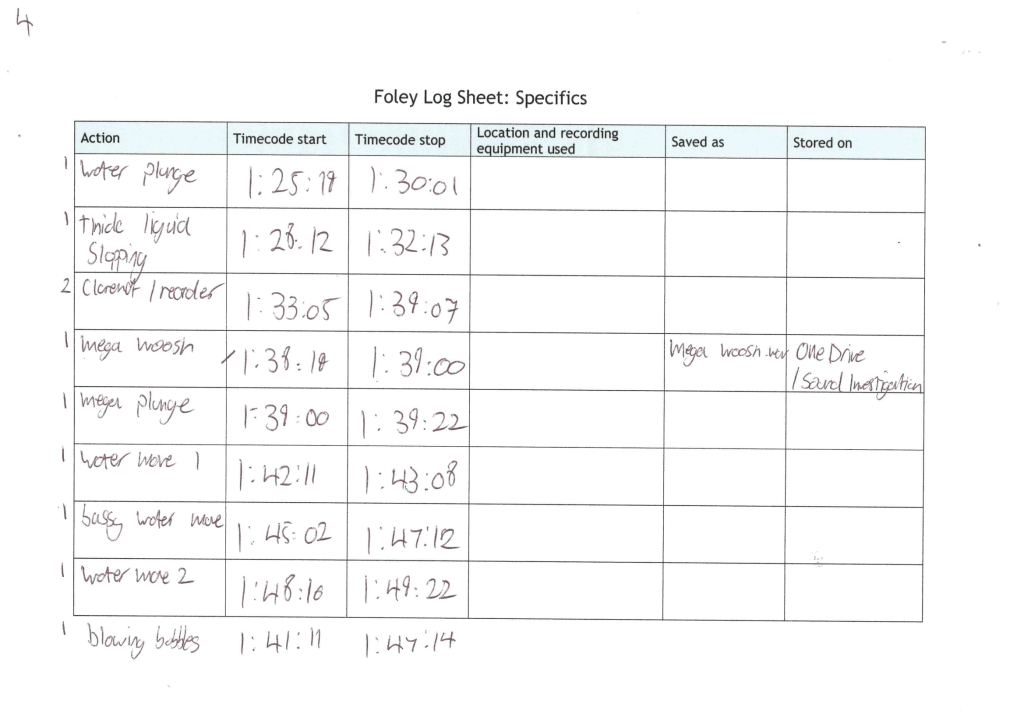
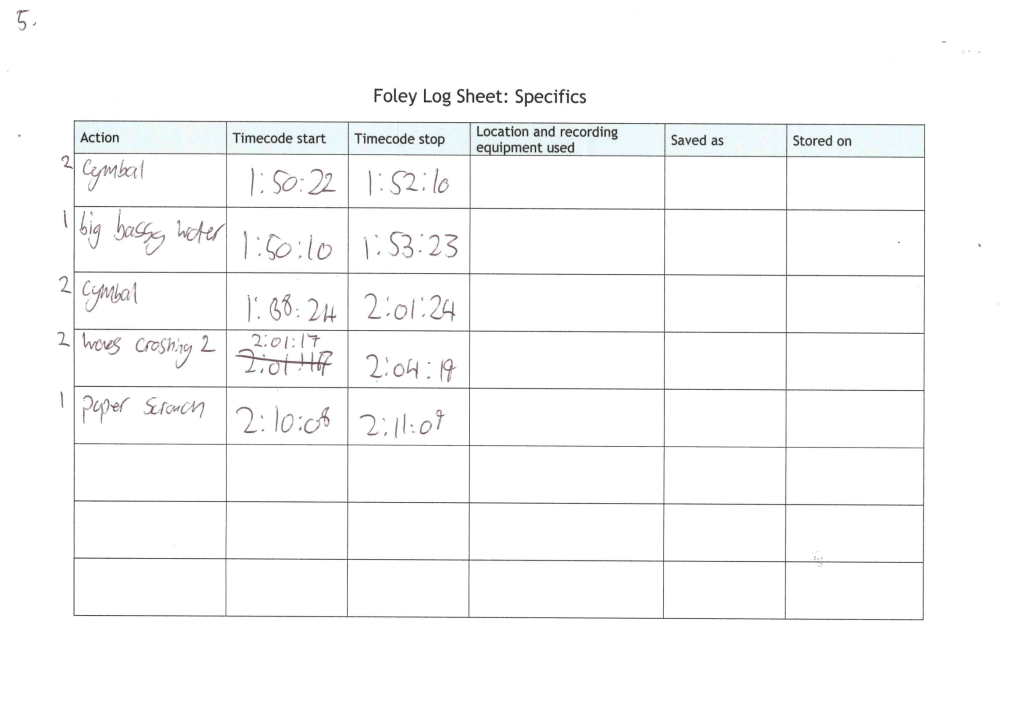
On the log sheets I have put either a number one or two next to each sound, and this represents weather I am going to get the sound from an online library or record it myself. There is a total of 38 different sounds that will be put into the video, and 24 of these I am going to record myself and the remainder will be sourced online. The sounds that I will get from libraries are all ones where it would be too difficult to achieve them within the timeframe. For example, a bass drum, to organise to record this instrument would take a significant amount of time and it is not worth it when I can source a perfectly good sound effect online.
Explanation of my main decisions
I have chosen to create the WWF film using my own created sound effects and sound effects from libraries online because… The sounds used in the WWF film are more interesting and will be easier to recreate especially at home with the equipment I have. In the original video you can really feel the adventure and woodland vibe, with it all being paper and trees etc, and I have tried to carry on this tone with my new sound effects, instead of changing the positioning and sound effects themselves, I have chosen to improve and recreate most of them while still adding some myself. The main soundtrack I have chosen already fits the video and the mood of the video very well, I think that this will still match the video and along with the sound effect bring out even more of the emotions that was intended to come out in the video with the original sound. I hope that my final video shows a deeper meaning than the original does.
Progression
To start with I thought that it would be the best idea to find the main soundtrack (song) to go with the video, I wanted to find something that would fit the video while still being better. My first port of call was the YouTube music library, as the majority of these when uploading to YouTube are copyright free and don’t need to be credited within the video or the description. To check if a song worked, I had the video open in Adobe Premier Pro and just dragged and dropped the sound clip from my downloads folder and played it alongside the video to check if the two work well together. And luckily for me it was the third or fourth one down through the list that seemed to fit the mood, and I think that it will work well even with sound effects in the background.
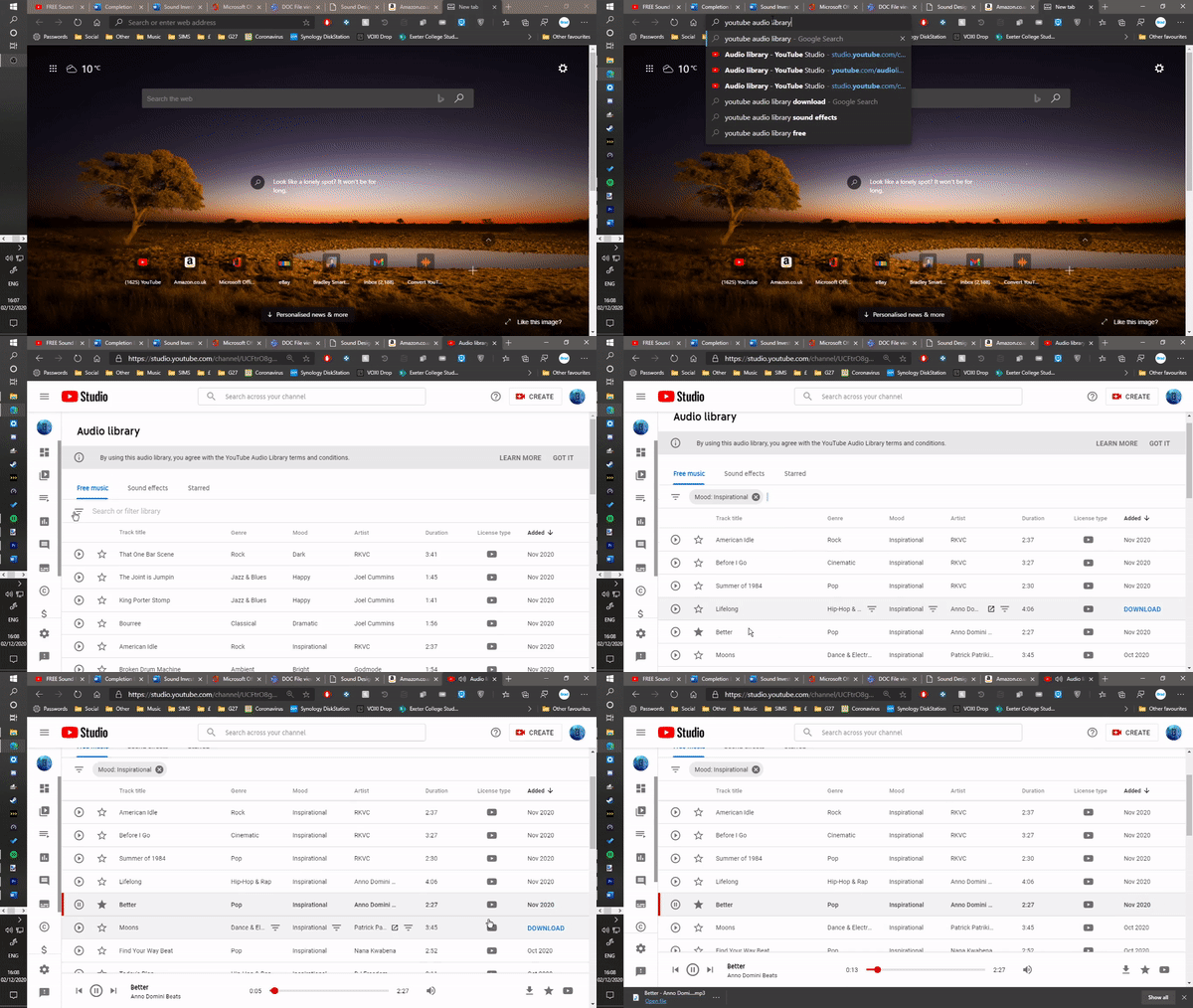
Personally, I thought the song worked well, but I wanted to get an unbiased opinion from multiple different people to see if they think it works well too, so I sent the video to five of my friends (before I explained that I had removed the sound and replaced it) and asked their opinions, see the picture below.
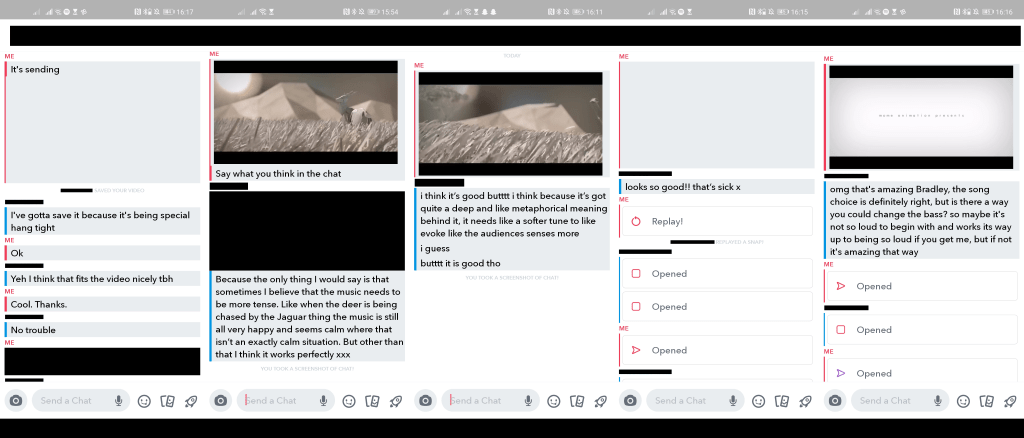
There were two people that gave more specific feedback, as to what can be improved, and I will make sure to address this before producing the final video, the first one being that the music needs to be more tense more specifically when the lion/tiger is chasing the deer, they said that it still seems too happy when it isn’t a specifically happy scenario and a way that I can improve this is by adding in an extra drum beat throughout the part or a sound effect for when the deer’s feet are hitting the ground for when it is running. And another said that the song is good, but it needs to sound softer because of its deep metaphorical meaning, I would say this is incorrect because the sound in my opinion is deliberately harsh because that is wat the WWF are trying to combat (forest fires, deforestation), so I wouldn’t say this is necessarily a bad thing.
I started to create the sounds. The method that I used to do this is was my having Premier Pro open on my pc and recording into audacity and exporting it to OneDrive and then using a dragging dropping method to add them into the timeline from OneDrive. The reason that I recorded it into audacity first instead of directly into premiere was because I used quite a cheap microphone which picked up lots of interference and background noise, audacity has a feature called noise reduction which helped to combat this. Once I had recorded the sound, I saved it to OneDrive and wrote down the file name and where it was stored onto the Foley log sheets.
Completed Foley Log Sheets:
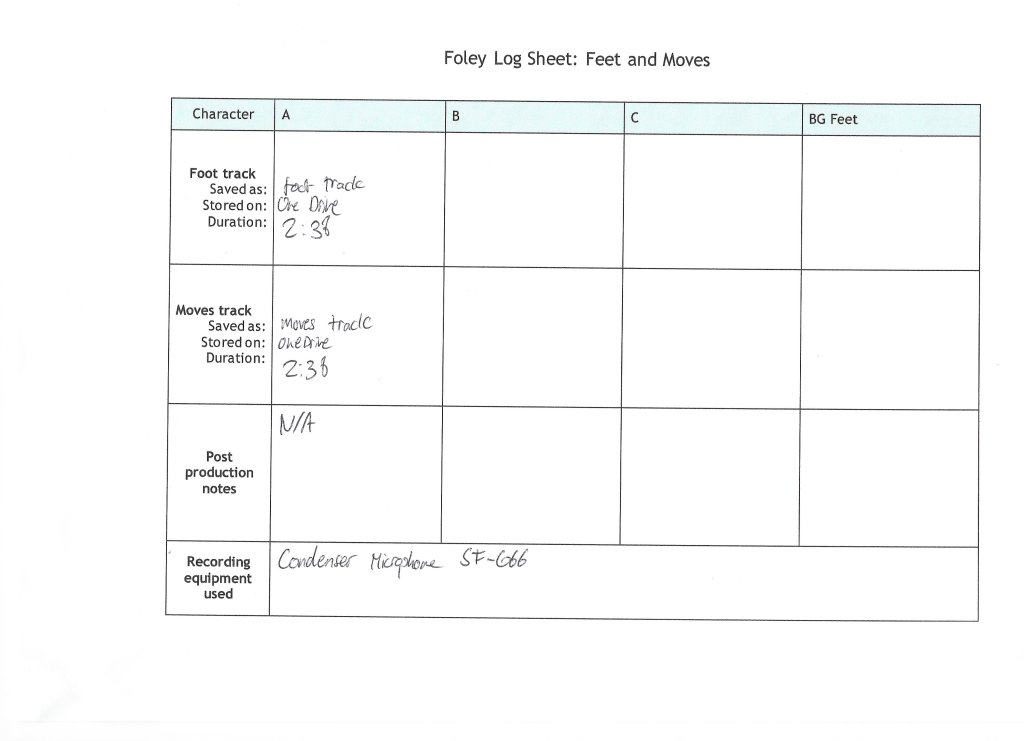
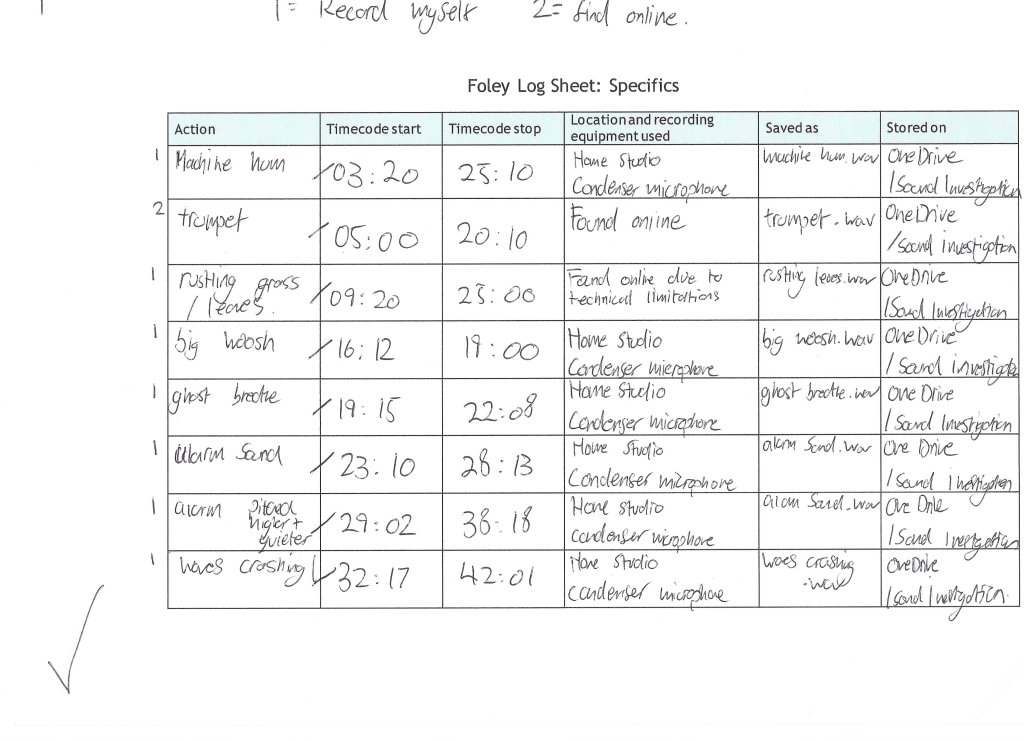
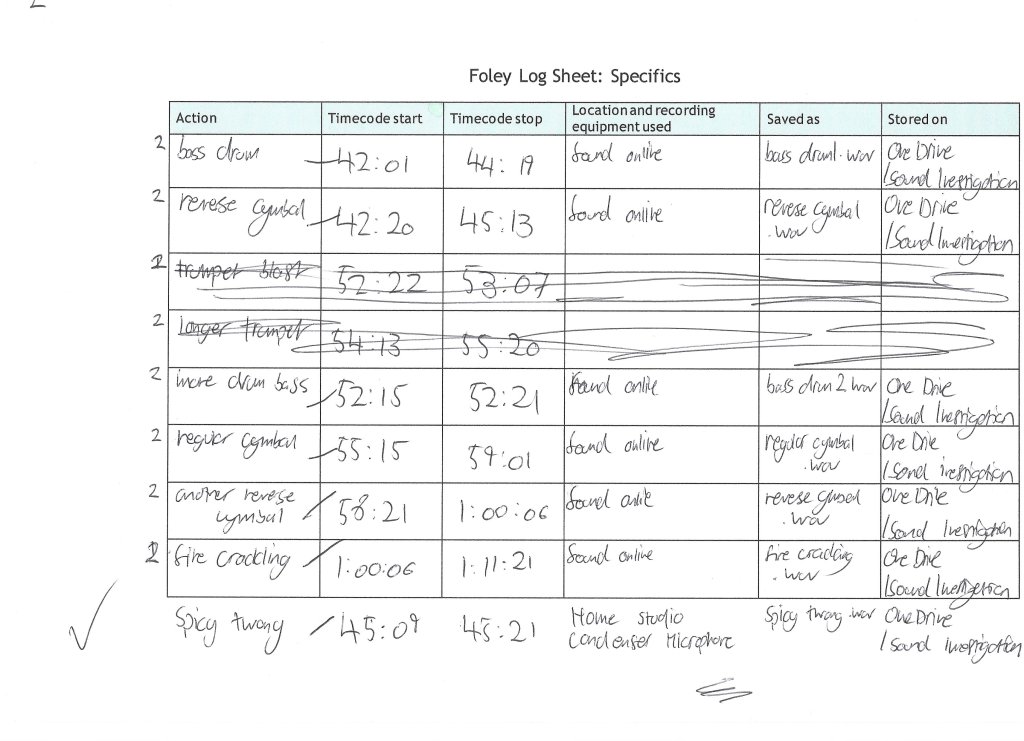
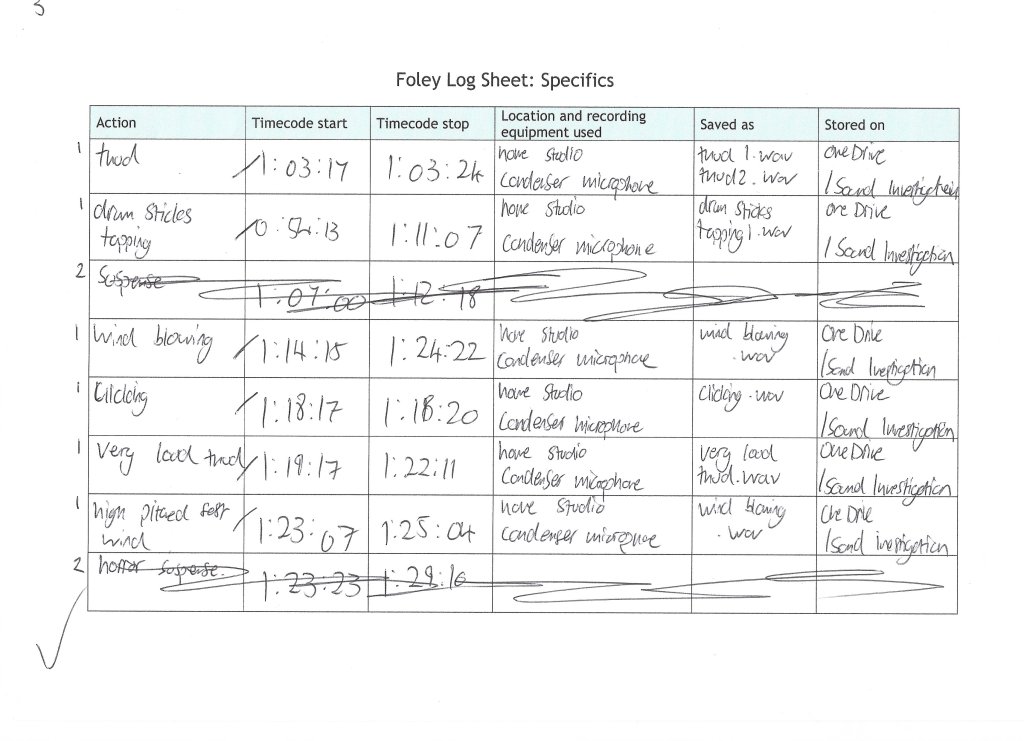
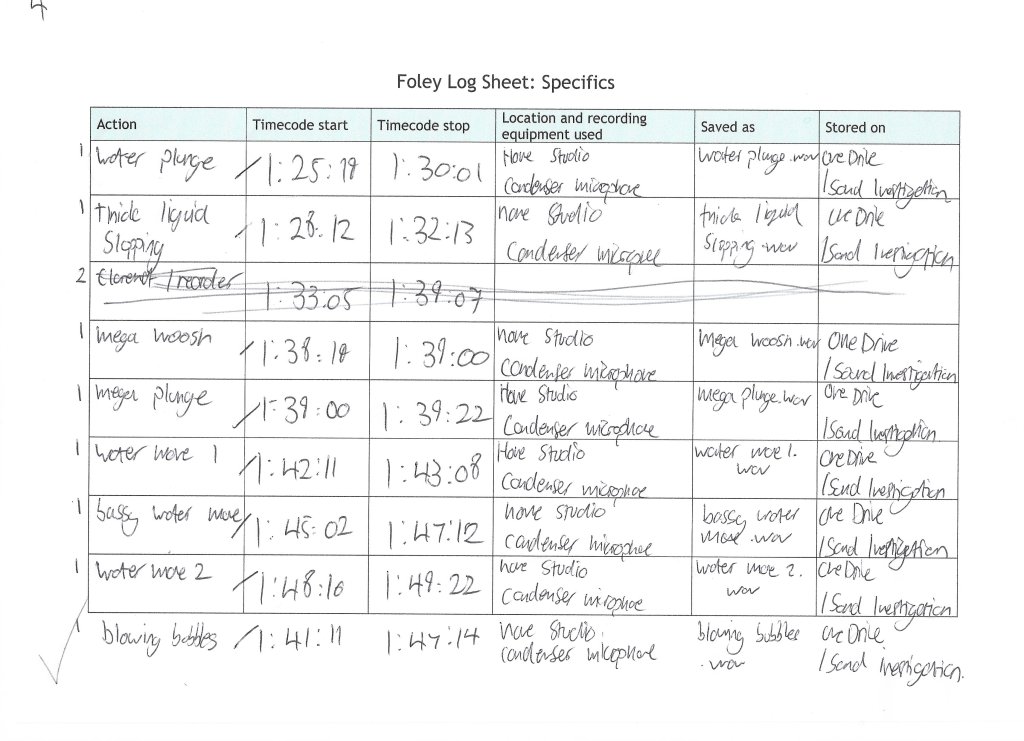
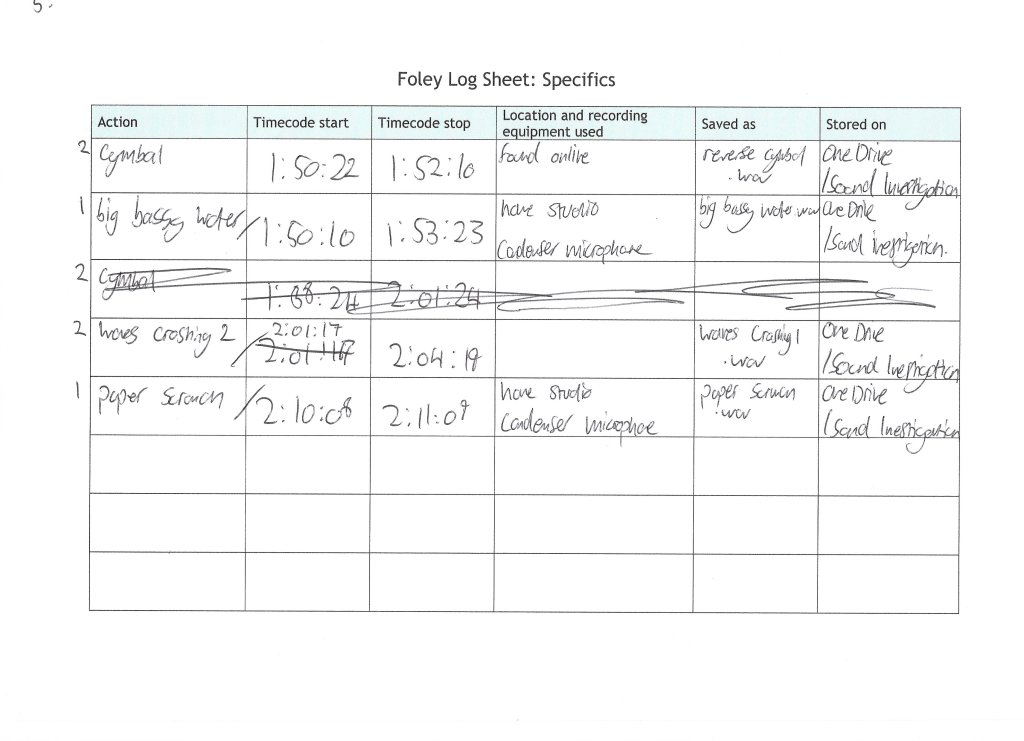
Below is a screenshot of my final timeline that I used to export the final video with the new sound track.

V1 and A1 (on the left) are the two tracks that enclose the original video with the uppermost being the video layer and below it the original audio for the WWF film. Track A2 is the song that I chose (Better – Anno Domini Beats). Tracks A3-A6 are all movements (move track) that are either the horse, paper falling or even the paper ball rolling. Tracks A7-A12 are all background/ambient noise that still contributes a great amount to the video but isn’t seen to be a main object in the video (foot track).
Below is a video of the timeline with the finished video playing over the top. This shows you when the audio tracks are starting and stopping.
Here is my final video with the new soundtrack below.
The clip uses a mixture of diegetic and non-diegetic sound. Diegetic sound as an example would be a bird flapping its wings, as we can hear this movement and it would have happened if it were filmed/realistic. And the only non-diegetic sound would be the music throughout, and this is because it isn’t involved within the scene and is added in post production.
Click the button below to view all of the files I have stored for the Foley problem.
Radio Problem
All radio dramas have specific and distinctive features, and the one that I have found to be most dominant is the fact that they are all separated with different scenes like a stage show, this can be shown by using or not using sound. Sometimes the creator may choose to use a sound effect between scenes with different characters, or they might instead opt for no sound between scenes whatsoever and just leave a big pause before a new character speaks. Sound is used in many ways with some radio dramas choosing to use ‘filters’ on top of the actors voice to make it sound different than usual, a good example of this is using a robotic filter on top of an actors voice it… well surprisingly makes them sound like a robot. A voice over is commonly used to introduce or to give some background information before the main storyline begins, this is so that the listener has enough information about the characters/plot so that the storyline makes enough sense, this usually helps if this voice is done by a voice actor who is not playing the role of a character within the story otherwise this could get confusing. From the two radio dramas I have listened to the sound effects that I have found work most effectively are ones that are made by characters as if it were a TV drama, for example the different sound effects for making a cup of tea like a kettle boiling and the pour of water, help to give some background information as to what is happening within the scene. As that’s all we as humans are trying to do with a radio drama; trying to picture and imagine what is happening as if it were real life, I also find (other people’s opinions may vary), that using sound effects of doors opening and closing help to distinguish and picture how many people are within a room at a specific point, it also helps if someone leaves a room mid-scene because as well as it being announced that they are leaving we will audibly hear this too, and because of this the dialogue within a radio drama needs to be very descriptive, if you took the sounds from a radio drama and recreated a video for it, it would seem comical. You need to add this kind of detail because they quite obviously lack the visual element that we need. Most of us do not realise how much we are analysing a scene through TV, but you realise this when you do not have the visuals. I think to tell a story a radio drama needs to be engaging and descriptive as everyone is so used to having the visual element that a radio drama lacks. These are the things that I will focus on the most when writing the opening of my radio drama.
As I have previously discovered in the research section the average listener to radio four is comfortably over the age of fifty, so while researching for a suitable topic I will have to make sure that it is something that this age group are either familiar with or, that they find interesting. A good approach now I think will be to focus on a current event (coronavirus), this would make a good topic because everyone knows about it and everyone has different opinion revolving the situation. I would attempt to write a narrative where an only child who is living with his grandparents brings home the virus to his family, and it up to the family to decide whether he did enough to stop the spread. The BBC have said themselves that they are known by their listeners for being a trustworthy source for news and current affairs. So, I think that if I were to write a radio drama around this it would suit radio four very well. Another idea that I had is to write about time, and how overnight it turned everything to two times speed, so everything that you do or can do, you would be able to in half the time. The only problem with this is that your human brain is still at a normal speed, so although you may be able to do things quicker you can’t necessarily ‘think of things’ quicker, I feel like this would also be good with an older generation (in comparison to me) because it will give them something to dwell on, and I feel it would be easier to engage with in comparison to my first idea as you would really have to think to get your head around the concept, the drama aspect of this is that it is unexpected, and that the whole world wakes up experiencing this change. I think that I will go for the idea around coronavirus, as it is a current event and much easier to understand and wrap your head around. I think that it will also be good with a younger audience as this is an issue that has affected a wide range of audiences and I want my radio drama to be applicable for all listeners. And most importantly to encourage a younger and wider audience.
Synopsis
A teenage boy attending college five days a week who is living with his grandparents in a small country village, catches the virus and brings it home subsequently causing the death of his already ill grandad, it is up to the family and the police to decide whether he could have been more careful and if he were not following guidance that would mean he did not catch it. Tensions build within the family but there is no way of proving that the teenager is at fault.
Character Profiles
David (Grandad – 69)
Grey hair, large bulky build, very opinionated and Loses his temper very easily and quickly but kind and caring and will do anything for anyone. Poor health, struggles to walk around for extended periods of time. Was a carpenter for his whole life but retired four years before this story takes place. Adam and Audrey are the only two people that he has left and he loves them both more than anything.
Audrey (Nan – 65)
Brown hair, slim build, slightly deaf. Tries to remain calm the majority and lets things build up before she gives any sort of a reaction, more reluctant to do favours for people. Highly active likes to exercise and keep fit. Works as an administrator at a cotton company. Has not had many different job roles and likes an easy life. Loves her only grandchild and cares for him.
Adam (Teenager – 17)
Blonde hair, slim build. Stubborn, and reluctant to help others, tries to focus on himself forgetting about the people around him. Goes for a run or at least one form of exercise every other day and does not eat the right food but it is not affecting his weight. Currently studying sports science at college as he wants to be a football coach. Misses his parents but still cares about his grandparents. Adam has lots of friends and is a popular character within college.
Write the first 5-10 minutes of your script
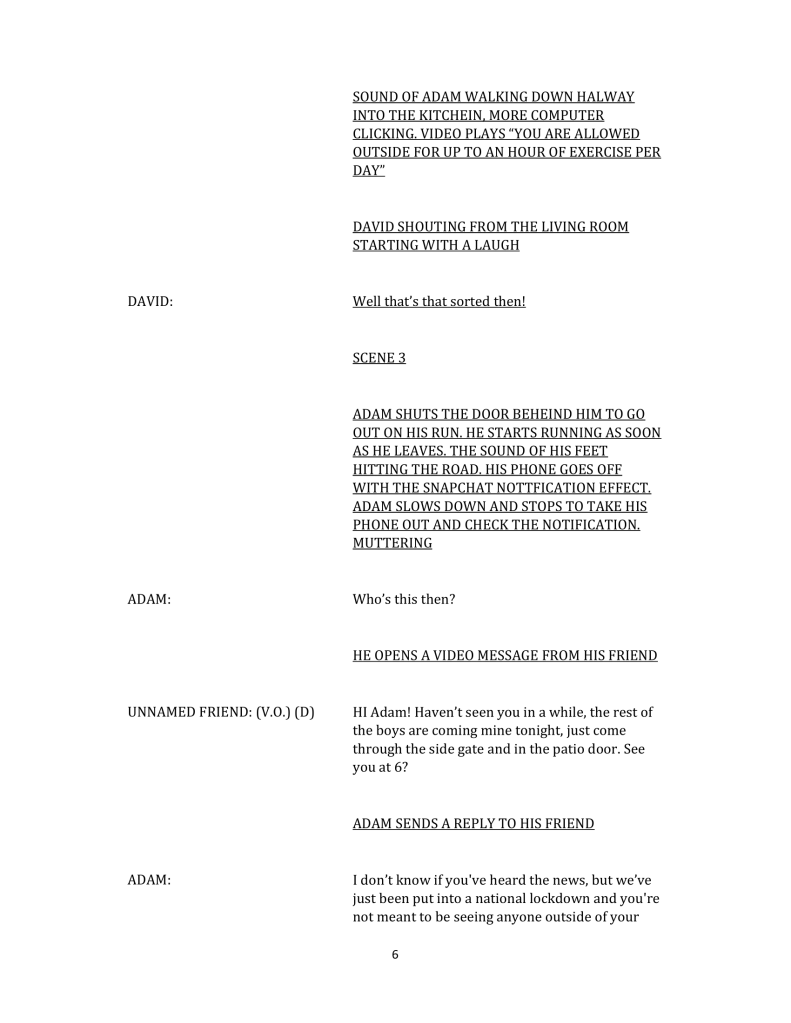
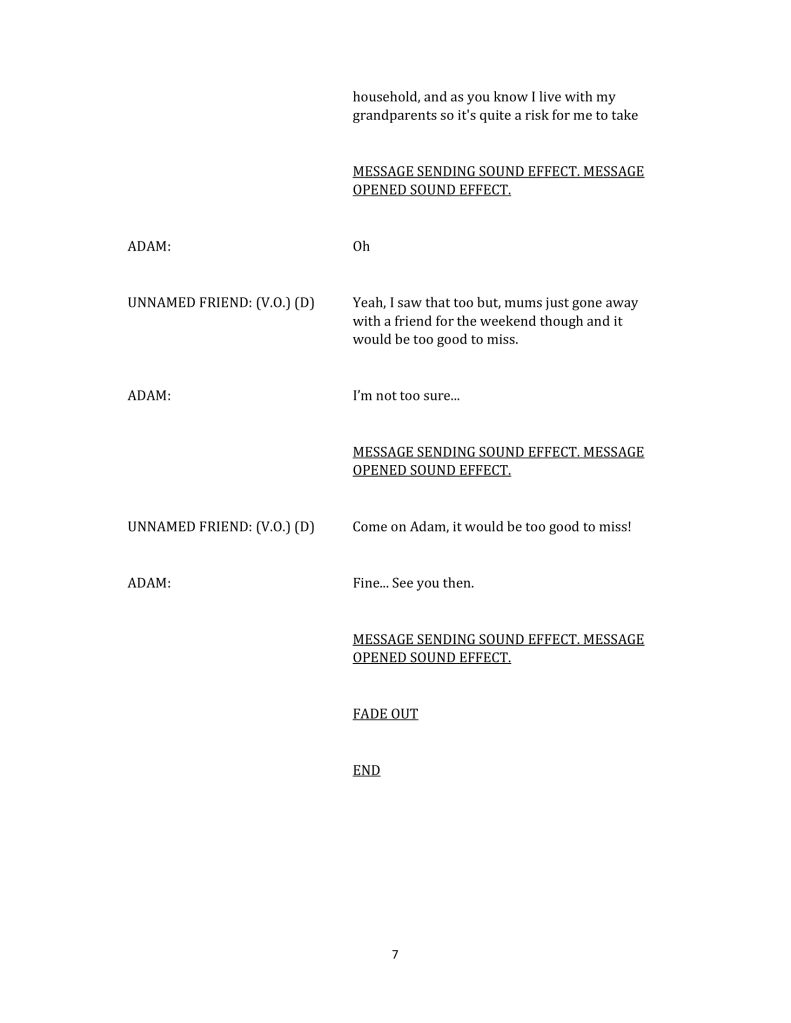
Below is pictures of the script I have put together for a radio drama. It follows the life of a teenage school boy living with his grandparents during a worldwide pandemic, and the decisions he should or shouldn’t make.

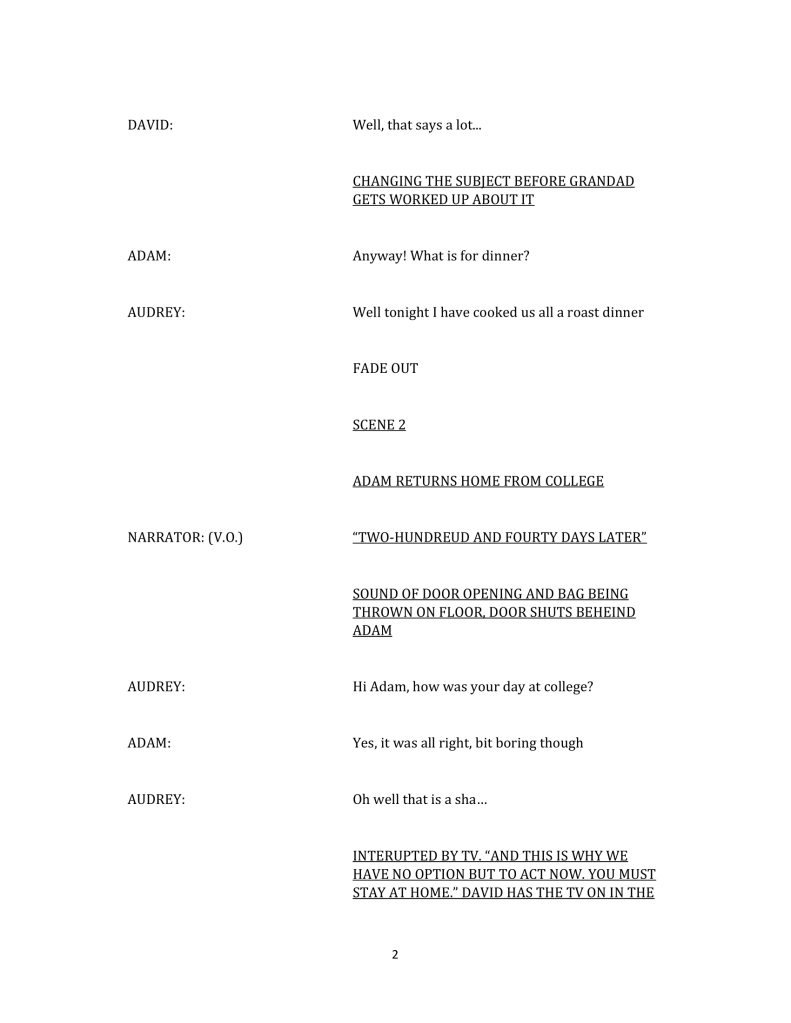
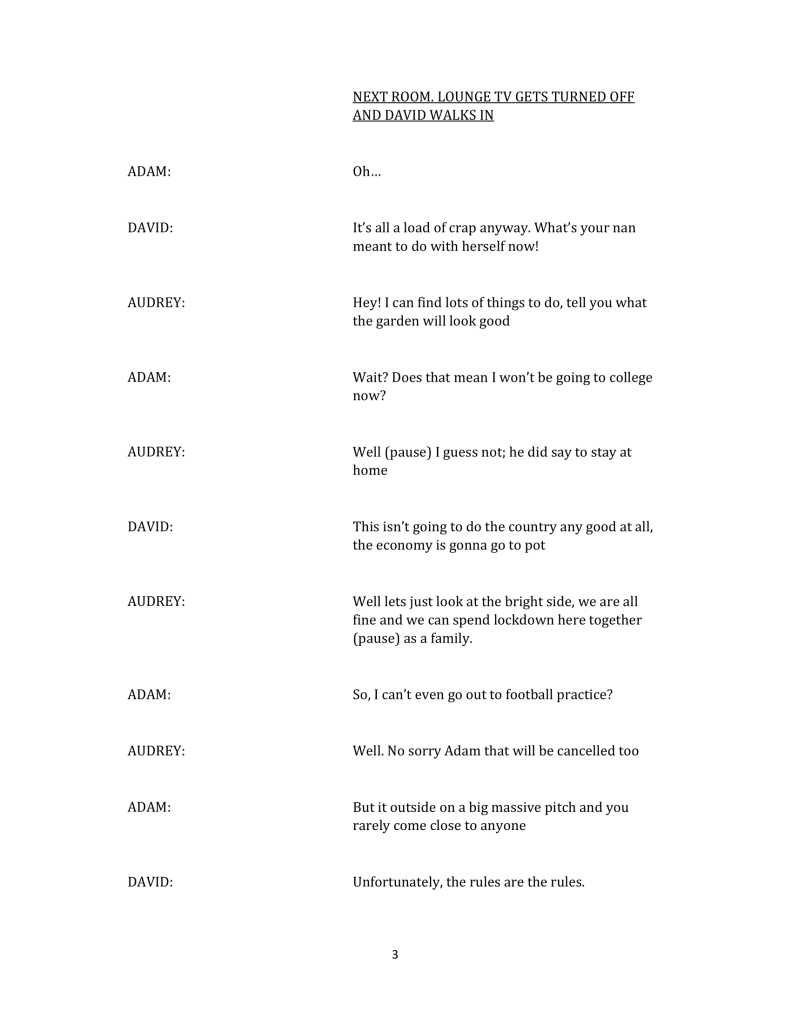
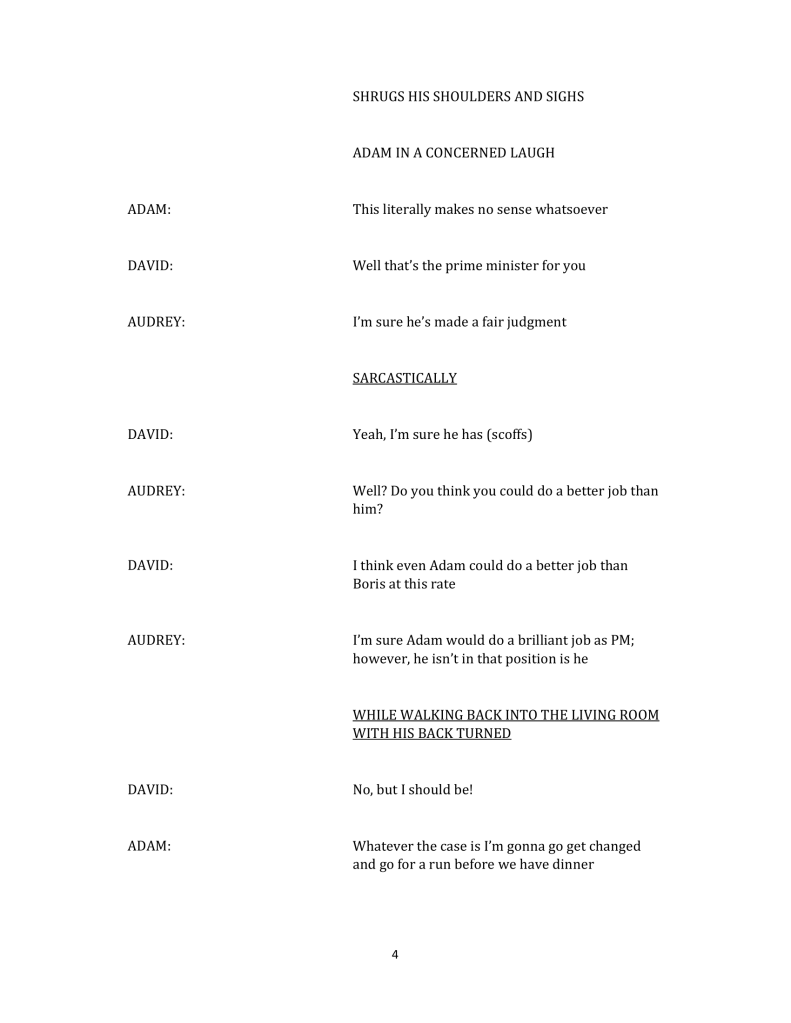
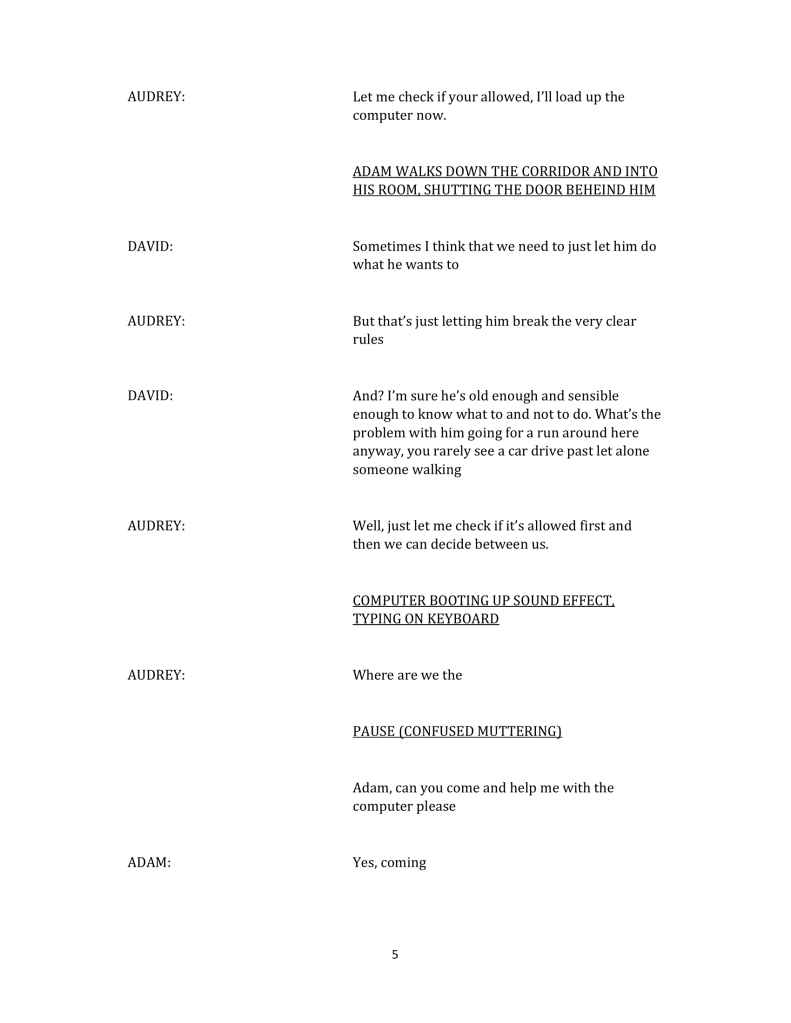
Part Four – (Evaluating your solutions)
I think that my radio drama has addressed the audience suitably, and I think that because I made it relatable. By creating a main character that is the same age or younger than the target audience, it allows the listener to be able to relate to the main content of the story as they will be able to relate to how mischievous they were at the same age, the story is also told to be a real choice of opinion and it forces the listener to be either for or against Adam and the different decisions that he makes. If I were to continue developing the script, I would make it very impartial to enforce this. I still think that older generations will listen to the radio drama however I am concerned that they may not enjoy it as much because it is aimed at a much younger audience.
The solution that I came up with to solve the foley problem met the original intentions. The original plan was to add in new sounds and recreate some from the original video while still highlighting the needs of the organisation, I also aimed to make the video much more modern and exciting/fast paced. The original sound for the video is too dull (in my opinion) and gets repetitive and boring easily. So, when recreating it I also aimed to make it more immersive, a technique I used to do this was by panning the audio between the left and right channels, for example, in the scene where the sticky notes are plunging into the water, when listening on a sound system or with headphones in you can hear that the notes furthest to the left of the screen come through your left eat and the right through the right, I also did this just before the bin hits the ocean floor, when the fish swerve out of the way and used the same method. By making it more immersive like this it makes the viewer want to stick around and see what happens next, I think it adds a level of suspense to the video. When I first started creating the sounds I had very low expectations of what I would be able to produce, as I only used a small cheap condenser microphone to record all of the sounds with but it showed me what can be done with little equipment and also how much can be changed in post-production, but during the process of recording and overlaying the sounds into the video I started to realise, not how easy it is but how creative creating the different sounds allows you to be, and in the end I managed to produce a video I am very pleased with.
I created many different sounds, most commonly would be the woosh of wind, as this is a common element throughout the video, the most interesting sound I created would be from [1:28-1:32] of the video where the bird seems to be stuck flapping its wings in what looks like ink, by this point I had already created the other sounds of the fish within water etc. And I didn’t want to use just water to show this sound as it would have sounded too dull and light as it doesn’t have the same consistency as ink. So, I decided to use porridge oats added to the water to give it the same thickness. Please see the video below to see how I recorded the sound.
Not all the sounds I created were successful, for example when the fish move before the bin hits the water as previously described, I first tried to record these sounds through a sandwich bag underwater as if you could hear them as if you were there, this didn’t work because when the microphone was underwater and I moved the water around with my hand it ended up moving around the bowl and hitting the microphone which created a lot of distortion because everything seemed amplified underwater.
The main strength of my work I would say is the efficiency that I work at, I think I work at a good rate and also manage to keep my work to a good standard. To improve my work further I would start to document the process more, for example recording the sounds. Looking back on it I wish I documented how I made each one of them. For the radio drama I think that I could have done better primary research by asking different age categories rather than just a younger audience, who mainly all shared the same opinion.
We were tasked to create a T-Rex sound effect, so to do this I decided to use four different sounds to produce the one listed below. Firstly I dragged a cat meowing onto my timeline and slowed it down to twenty five percent, I followed with this ‘family pet’ theme and added in a dog bark and followed the same process. Below this I put in some thunder and also jingle bells for a christmassy theme!
According to the book ‘The making of a Jurassic Park’ the famous t-rex roar is actually three different sounds combined together… a baby elephants squeal, an alligators gurgling and finally a tigers snarl.
 Bradley Smart